October 13, 2006

Improving customer relationships

Something Like Life
Oct. 13, 2006


I WAS in Singapore again recently to cover an event, and it always blows my mind how this tiny city-state managed to be one of the most efficient nations in the world. You can say anything you wish about Filipinos being hospitable (mostly to foreigners) but, sadly, we can’t beat the Singaporeans in terms of professional customer relationships.

Okay, okay, I know some of you can no longer stand reading stuff about why some countries are better than ours (truth hurts doesn’t it?), but I just have to say my peace. Because I can’t imagine how we Filipinos—who are in demand all over the world because of our courtesy and how we put clients’ needs before our own—can do such a bang-up job here at home. And if we are supposed to make it in the global arena, we have to learn how to treat each and every customer with respect.

I have to give props first of all to the Palm technical support staff in Asia. I had sent them a few electronic missives from here in Manila to report that my phone, a Treo 650, was going nuts on me. They came back to me with clear, concise instructions on how to address my problem technically. Telling them that the reboots they suggested didn’t work, they told me that I could drop off my unit at a local address and Palm would ship me a replacement in three to five days from Singapore.

The tech staff also told me that if available locally, I could get a swap immediately instead of waiting for a replacement from abroad. I never got the chance to do this as I became too busy with my assignments. (Also I was too scared to actually part with my unit, which I have become dependent on to organize my life.)

When I had the chance to go to Singapore, I jumped on the opportunity to renew my communication with Palm tech support. In less than a day, I got my replacement unit without having to submit any paperwork or voluminous documents. All I had to do was give the serial number of my unit, pay a minimal fee by giving my credit-card details (as my unit was considered out of warranty), then drop off my defective unit at Palm’s Drop Off Zone at Tang’s. (Even going to Tang’s from my hotel which was three MRT stops away, was no big deal, as I just jumped on the train, got out, took the underground connection which led me across the street and up to Tang’s. When I finished, I returned to my hotel the same way. The entire exercise was completed under an hour, and would have been shorter if I didn’t walk around the displays of the gorgeous techie toys. How’s that for Singaporean efficiency?)

In contrast, my telco provider, which had given me the original Treo 650 through my postpaid subscription plan, has turned out to be a model of extreme inefficiency. I love my telco provider to bits, but since it has grown bigger, I think it is now suffering from too much bureaucracy. One would think the government has now taken a majority stake in it.

What’s more, the telco’s success has obviously swelled the heads of many of its executives who can no longer even answer simple questions from the media or the public. Wonder no more why its closest rival has been attracting more and more customers. Most are probably “switchers,” people who are no longer satisfied with this telco’s services that they just had to “switch” to its rival.

First off, I didn’t have any international roaming services even though I had signed up for it. In vain I tried to surf my telco provider’s site on how to activate the international roaming feature. Of course, after wading for what seemed like an eternity through a totally nonuser-friendly site, what confronted me was another dazzling display of low-tech nonsense where I was told that under my subscription plan, I could “Go out and roam! You are all set. No application, no fee required.”
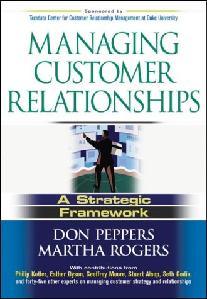
(Read books like this guys! It might actually help your company improve and make your executives behave less of an ass.)

When I returned to Manila, I wrote to my telco provider’s customer service about my problem, and a representative e-mailed me back saying:

“Upon checking, International Roaming feature for mobile no. xxxx is inactive. Although your account is entitled to this feature and International Roaming deposit is waived, activation of the feature necessitates submission of signed letter of request and valid ID.
The scanned documents may be sent through this channel or fax to 8487-8807/848-8870.”


Whoopdeedoo! Welcome to the 21st century!

Of course, I told the customer service representative what I thought about this idiotic instruction, and she responded by saying that I could go instead to the telco provider’s web site and activate my international roaming service online. In other words, there was no way I could get roaming service because, as the site had cheerfully declared, I already had roaming!

I then called the telco provider’s PR department and one of its officers finally got back to me after two days, saying that he already had my international roaming service activated permanently. He added that there was also a problem with the telco’s partner in Singapore, which was why I was unable to roam. So what really was the reason for my phone not being able to roam? An unactivated roaming service or a defective Singaporean partner? Oh brother!

Thing is, I never ever had any problems using this telco’s services. I’ve been subscribed to this telco as far back as I can remember. Roaming abroad had never been an issue for me up until then. I land in another country, I switch on my phone, and I am automatically registered to whichever is the telco provider’s partner is in that country. I upgraded my plan last year so I could get even better services. Or so I thought.

Of course, now that this telco is such a success, it can’t help but be a victim of its own arrogance. In the process, it has alienated its own customers. (One columnist in another paper had also recently written about its bureaucratic unintelligent customer service. And, mind you, he was about to become a new subscriber after the telco’s CEO encouraged him to get a plan. Of course, you can pretty much guess what the columnist finally did to his application.)

So why are Filipino companies so bad at dealing with customers here at home when we’re supposed to be the best at this everywhere else? Sad to say, I can’t figure it out myself. Times like this, I just wish I lived in Singapore.

(My column Something Like Life appears every Friday in the BusinessMirror.)

P.S. I just found out that the Palm Technical Support Staff is actually based in Manila. So that just proves my point that there is a huge difference when it's Singaporeans who manage the customer services, instead of Filipinos like those belonging to my telco provider. Sad, sad, sad.

Asian Spirit: Only 25 minutes from Manila to Boracay

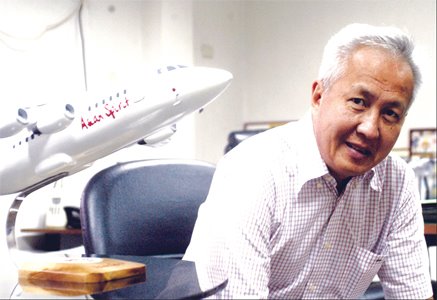
JACK PO, executive vice president of Asian Spirit, announces that the airline is aggressively expanding to Asia and Micronesia, in addition to offering faster service to travelers to Boracay.

By Ma. Stella F. Arnaldo
Special to BusinessMirror, Oct. 12, 2006


FLAG carrier Asian Spirit will be offering a faster service to Caticlan, the gateway to Boracay in November, and is aggressively expanding its reach in Asia and Micronesia.

In an interview, Jack Po, executive vice president of Asian Spirit, told the BusinessMirror that the jet service to Caticlan will add three more daily flights to the airline’s current 16 and will only take 25 minutes from Manila.

The carrier will be using a British Aerospace 146-100, normally an 80-seater, but reconfigured to 60 seats to enable it to take off and land in the short Caticlan runway.
BAE executives were in town last week to test the reconfigured jet. “The test flight was successful and went without any hitches,” said Po.

The 25-minute service will top its rival Southeast Asian Airlines (Seair), which currently offers a 35-minute flight to the Aklan seaport. Seair uses a 32-passenger Dornier 328 turboprop for its Manila-Caticlan flights.

More routes

Flushed by the success of the test flights, Po also announced plans to fly to Macau; a new route to Pohnpei, in the Federated States of Micronesia (FSM) from Koror, Palau; and a flight between Cebu and Koror.

He said the air service to Macau, to be offered in mid-December, is a tie-up with budget carrier, Viva Macau. The flight will use Viva Macau’s planes, either its 181-seater Boeing 767-200 or 245-seater B767-300.

“The service will initially be four times a week, and will depart from Clark,” Po said. The departures/arrivals in Clark ensure no direct competition with Air Macau, which is currently flying the Macau-Manila route, with a code-sharing agreement with Philippine Airlines.

Founded in 2004 by former Cathay Pacific general manager for international affairs Andrew Pyne, Viva Macau will also start offering services in November between Macau and Jakarta, Indonesia, and to Male, in Maldives. The carrier also hopes to offer flights to the Middle East and Europe.

Viva Macau has an existing international licensing agreement with Air Macau, the territory’s flag carrier, allowing it to fly the latter’s international destinations, like the Philippines, but using other arrival/departure points.

Asian Spirit is also planning to fly from Koror in Palau to Pohnpei next year, a route presently served by Continental Air Micronesia three times a week. According to the Continental web site, Pohnpeians transit through another FSM state, Chuuk, and Guam, and then change aircraft for the flight to Palau, making the trip long and circuitous.

Another route is through Honolulu and Guam before landing in Koror. There are two stops in between Pohnpei and Honolulu at Kosrae, FSM and Kwajalein, Marshall Islands.

An obstacle to the planned service however, is the lack of a refueling facility between Koror and Pohnpei. Ideally, a fuel stop has to be made in the island of Yap, but oil giant Mobil had already closed its refueling facility.

Asian Spirit plans to use its British Aerospace 146-100, an 80-seater plane, for the route. “With a refueling facility, we can use our jet and connect to Yap and even to Chuuk,” said Po.

If the refueling facility is not opened, he said Asian Spirit would have to buy “a long-haul aircraft” to service the said route. He expressed confidence that another plane could be purchased by the airline using “internally generated funds.” Talks are ongoing between the Pohnpei government and Mobil executives to reopen the refueling stop.

Micronesia is famous for its diverse marine resources making it an attractive area for scuba divers and game fishers. Po said the Koror-Pohnpei could “open the gateway to Yap” and other Micronesia states, which have a lot of tourism potentials. “It’s part of [our] plan to expand into Micronesia,” he said.

Koror to Cebu

Aside from the tourism potentials in Micronesia, Asian Spirit also wants to cater to Filipinos who are working and leaving in the Micronesia states. With the airline’s existing route between Koror and Davao City, it will be easier for Filipinos to connect to Manila or other provinces using the flag carrier’s other routes.

Before Asian Spirit can fly the Palau-Pohnpei route though, a bilateral air-service agreement has to be forged first between the Philippines and Pohnpeian government. In lieu of that, the Philippine flag carrier can use the flying rights of Palau Micronesia Air (PM Air) to service the said route. PM Air is the general service agent of Asian Spirit in Koror and holds flying rights to Micronesia, Japan and Australia.

In an e-mail to BusinessMirror, Surangel Samuel Whipps Jr., whose family coowns PM Air said: “PM Air has rights to fly to the FSM [Federated States of Micronesia] and would like to cooperate with Asian Spirit in expanding its route to the rest of Micronesia.”

According to data from the Philippine Overseas Employment Agency, 393 Filipinos were deployed in FSM (Chuuk, Pohnpei, Yap) in 2005, 10.48 percent lower than the 439 deployed the previous year. The data includes new hires and rehired land-based personnel.

Asian Spirit is also finalizing plans for a Koror to Cebu City route, which aims to target Europeans who are going to Palau. The service will also cater to OFWs in Palau who want to come home, and also to Palauans who can fly to other international destinations using Cebu as a jump-off point.

“There is a bigger market in Cebu and it has better international connections,” said Po.

Several domestic Philippine carriers are now aggressively pushing their expansion in the international arena, competing with pioneering flag carrier, Philippine Airlines. The budget carriers hope to boost their sluggish incomes with revenues from international routes. Domestic revenues have tapered off due to the rising cost of aviation gas.

Many of these local carriers, such as Asian Spirit, Cebu Pacific and Seair, offer no-frills, inexpensive travel between several points in the Philippines and key Asian destinations such as Korea, Japan, Singapore, Hong Kong, Shenzhen and Xiamen in China, Macau and Palau.

October 12, 2006

Reeling: Truths, Art & Classification

by Tito Genova Valiente

THE silent film opens with a man and a woman, strongly reminiscent of a primordial scene in the Garden. The two ill-fated lovers, as the program notes of the filmmaker label them, are looking up to a mango tree, a blackened fruit dangling and seducing the female. The woman named Guima says: I want eat mango. The man Aras replies: No eat mango. Sand god forbids. You know the rest of the story—the man turns his back and the woman eats of the fruit of some Tree of Whatever Good and Whatever Evil. In this tale, the woman partakes of the forbidden fruit as her man cools off and takes a dip. As the man walks to the water, we glimpse upon the warning that the waters are not fit for swimming or wading.

We know what happens when people do the forbidden. Something horrible is bound to befall upon them. Aras is drowned and resurfaces as a zombie and Guima is transformed into witch having frenzied sex with the men on the island. Mang Kepweng, the hermaphroditic witch doctor who is the only one who survives the killing caused by the toxic mango, chases the two monsters and slays them. As they lay dying, Aras asks: Why you eat mango? Guima replies: Why you very black? Then the screen darkens for the ending.

The short film bears the title Toxic Mango. It is part of the “Guimaras: Shortfilms from the Oil Spill,” a project by the Philippine Independent Filmmakers Cooperative for the TV network ABC. The Philippine government through its instrument, MTRCB, has X-ed the film.

It is quite a journey for a film that is part of a company that involves such names as Kidlat Tahimik and my good friend Roxlee, and figures known for pushing the boundaries like Raya Martin, Milo Paz, Emman de la Cruz, Jeck Cogama, Paulo Villaluna, Wilfred Galila, Kidlat de Guia, JP Carpio, Seymour Sanchez, Ann Shy, Victor Villanueva, Drei Boquieren and Oscar Nava.

It is quite a slap, too, against a move by a group aiming to raise the awareness of the people regarding what is considered the worst oil spill in the history of this country’s islands through a potent and quirky medium they have individually and as a group developed.

Hexed and vexed

Documentaries have always been a problematic tool. They are neither here nor there in approach. In fact, as Pauline Kael has put it: Many of us grow to hate documentaries in school, because the use of movies to teach us something seems a cheat—a pill disguised as candy—and documentaries always seem to be about something we are not interested in.

But documentaries change. One thinks of Michael Moore, who, in the words of James Wolcott in his Vanity Fair February 2006 article “Through a Lens Darkly,” had the brazen effrontery to bring the documentaries to another level. Otherwise, as Wolcott phrases, documentaries “might still be poor cousins [to other media] camped on the stoop, ringing the buzzer and being ignored.”

You may not like Toxic Mango. The anthropologist, Dr. Hiroko Nagai Yabut calls it a strange joke while marveling at its textured cinematography. Bloggers giggle as they try to decide what to do with the work. Our columnist Stella F. Arnaldo says it “is not a Sundance candidate” but surely it does not merit an X. Watching the short film, there is no debate: the piece does not merit an R or even a PG as we understand the implications of these subjective letters.

Legal minds say that when a piece is censored or “classified,” it is the duty of that censuring body or authority to explain its decision. It has to articulate and, even as most of you would wince, educate us about its informed decision, its avowed taste. Even for the nonlawyers, this makes sense. Picture this: the authority—be it censoring of classifying—demands that you appear before them. In their midst, you are asked to explain to them why your work is obscene.

Obscenity in the Philippines has generally been about bodily matters: frontal nudity, breast exposure, sex acts especially if they are represented by the disturbing “pumping” acts.

Lately, it has gone into the fashion tastes of singers and to the humor of our comedians. It is a scary proposition that people we do not know are up there, quiet and concentrated and isolated, are deciding for us what we should see, what we can see and what we cannot see.

These select few are our conscience, our arbiter, our taste. They explain to us why we cannot see things that they see. Most of the time, they do not explain.

Toxic Mango does not have these “sex” and violent things. What it has in terrific quantity is an irritatingly disturbing discourse on an environment gone crazy in a land that is lazy about its own salvation.

As of this writing, there are no documents out there explaining the position of MTRCB and clarifying its stand. For those, with access to computers, though, a service called YouTube is running for us the short film. YouTube is a consumer media company that allows people to watch and share original videos worldwide through a Web experience. (It was acquired recently by Google—Ed.) Through its technology, users can see firsthand accounts of current events, find videos and interests, and “discover the quirky and unusual.” In the meantime, the poison of Khavn de la Cruz, the man behind Toxic Mango, is dripping in and on the Internet without control. And without boundaries.

UPDATE: The filmmaker who has won awards in Tokyo, Spain, Germany, Italy and here in the Philippines says he is submitting a recut of his film to MTRCB so that it can be shown to the public. I, however, wait at the gate of YouTube to watch the condensed poison—to be irritated, to be angered, to be aware of how oil spill is not limited to Guimaras and other small, poor islands. To take a candy only to find out it is a bitter pill.

As for my promised Part II about the rebirth of OPM, I will continue my rhapsody on Tuesday; this topic on oil spill is more urgent.

(Originally published in the BusinessMirror, Life, Oct. 12, 2006)

October 10, 2006

Silver pesos: Elderly consumers challenge marketing concepts


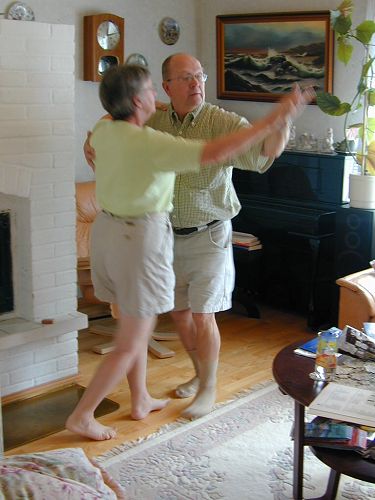
MY parents are both pushing 80. But it doesn’t show. They are both still active—my father still drives out to the grocery or drugstore, while my mother still does the marketing and goes out with her friends often. Both spend quite a sum on food (eating out or taking out), medicines, clothes, even junk food, every month.

And yet, I hear them complain all the time about the noise in the malls, or the loud music at restaurants, or how some store outlets don’t even recognize the senior citizen’s discounts mandated by law. Places with loud music—and there seems to be more and more of these—are unfriendly and inhospitable venues for senior citizens. My mother and her amigas, also don’t seem to have elderly-friendly activities to undertake— discounting ballroom dancing—and usually just end up having lunch as a major activity every month.

Unless it’s an arthritis medicine, an adult diaper or a hospital, there are really not many products geared toward the elderly generation, dubbed the “silver market” by Dr. Yuwa Hedrick-Wong, an economic adviser to MasterCard Worldwide in Asia Pacific. Dr. Yuwa has just come out with a book entitled The Glittering Silver Market, which chronicles the rise of the elderly consumers in Asia, and the exciting opportunities created for companies, given that these consumers have relatively high spending power.

In his book, and during a recent roundtable discussion in Singapore with select journalists from around the region, Yuwa outlines startling facts:

• Due to the wider accessibility to healthcare, and a better psychology, human beings live longer, and are active beyond the average retirement age of 65. “The elderly are living healthier and leading more active lives,” said Yuwa, giving rise to the phenomenon called “compression of morbidity.” He said this trend shows that as life expectancy rises, the average age of the onset of chronic illnesses also rises. “The elderly get sick usually only a few months before they die,” he explained.

• The mindset of senior citizens is now changing. In a global survey, two-thirds of the elderly beyond 65 felt these years as a “second opportunity in life.” “They have a desire to do other things,” he added.

• Women will outnumber the men in most of the countries included in the book, except for India. From a consumer market perspective, this is an important development as “women can bounce back from life and become active in the social network,” thus maintaining their place as consumers, according to Yuwa.

• As more people move from rural areas to urban areas—estimated at 90,000 per day, every day in Asia—the elderly population growth as a market will be more evident.

• Despite the traditional close ties among Asian families, across generations, more “silvergenerarians” now prefer to live on their own, away from their children.

• The discretionary spending of the elderly household in emerging Asia (China, Indonesia, Malaysia, the Philippines) is projected to rise to $430 billion by 2015, from $153 billion in 2005.

What this means

It was surprising for me to discover that of all the markets covered in the book, the Philippines has the youngest average age at only 26 in 2005, which MasterCard projects will rise to 28 in 2015. (Japan, expectedly, is the oldest, with one out of five Japanese now over 65.)

It is perhaps because of the relative youth of the Filipinos that local businesses cater mostly to the younger, so-called MTV generation, which has to be fed loud rock or heavy metal music all the time for them to enjoy shopping, dining and spending (mostly their parents’ money, of course.)

Companies spend billions of pesos in marketing and advertising to the youth as they are seen as a segment demanding the fastest turnover of consumer goods. Just look at how many times cell-phone companies or telecom providers come out with new phone models every three months. The youth get easily tired of their “stuff” and want newer products, no matter the cost. All they have to do is charge their purchases.

Yet it cannot be denied that the elderly Filipino market also presents a good-sized challenge to local businesses. By 2015, the silvergenarians are estimated to total 5 million, or almost 40 percent of the projected total population of 13 million, from 3.4 million, or 38 percent of the 9 million total population, in 2005.

According to Yuwa, of the estimated $153-billion discretionary spending of elderly households in emerging Asia, Filipinos accounted for $1.95 billion in 2005. Of this amount, the largest chunk went to dining and entertainment at $0.9 billion or P4.5 billion.

Every year, this discretionary spending is estimated to grow by 13.4 percent, reaching almost $5 billion by 2015. The largest growth, at 11.4 percent, would be seen in spending on auto, personal computers, mobile phone, and others at $0.2 billion or P10 billion.

Yuwa noted the large contribution of overseas Filipino workers in supporting the elderly in the Philippines.

“The vast majority of these overseas workers leave behind their spouses and young children. In many instances both parents work overseas, leaving the young children at home. Thus, a situation is created in which the grandparents (and sometimes the granduncles and aunts) serve as surrogate parents for the children of overseas workers,” he said.

“The overseas remittances support the family, including the elderly who are at home taking care of the grandchildren. And, for the elderly themselves, their role as surrogate parents enables the parents to seek work abroad. It may not be ideal, but in many ways, this is a win-win situation for the elderly, the overseas workers and the children left behind.”

Because of the OFW situation, the spending power of the elderly, which include retired empty nesters, as well as old singles, is projected to grow to $6.8 billion by 2015, from $4.4 billion. Think of the marketing possibilities for this segment in the society!

Perhaps other businesses can take a cue from the local property market developers who are now actively seeking out the OFWs who want to retire in the Philippines and other foreign retirees, to sell their future projects. Ayala Land Inc., for one, is already designing a retirement village with European and Asian retirees in mind, with all the amenities needed by the elderly such as recreational facilities, telecommunication and Internet connections, a nearby hospital or a well-equipped onsite primary health facility.

“If I were a developer today, I would think of developing flats for the elderly. They don’t need much space but everything is geared toward the elderly—from the bathroom, the kitchen, but they only need one bedroom. I would build this facility right next to a good health center, fitness center, make it all convenient. These are all business opportunities,” Yuwa said.

Tourism

Local tourism is another sector that will benefit immensely by targeting the elderly market, specifically those from Japan.

According to Yuwa, Japanese senior citizens come in second to the 35- to 45-year-olds in terms of frequency of overseas travel. Most of these Japanese elderly, he added, are women —whose travels are tied to a specific lifestyle interest. They like visiting, for instance, places of historical interest, cultural interest.

So as a tourism destination, they have to tap that growing trend, Yuwa advised. They have to preserve their historical sites of interest and make it easy to travel and visit. They should also have local museums and curators who can provide information and engage the elderly. Make resorts and hotels elderly-friendly, he said.

What’s more, Dr. Yuwa noted, these elderly Japanese women are making their bookings via the Internet. This alone already debunks the misconception that the elderly are afraid of new technology.

Other businesses that could benefit from catering to the elderly include recreational or sports facilities and elderly wellness management, where there is a rapidly increasing need for gerontologists or specialists in preventive medicine and wellness management who could help the elderly live healthier lives. These specialists include even nutritionists or exercise trainers, he clarified.

The challenge, of course, is developing the right products for the elderly, and not make them feel, well, old. Marketing specialists, if their clients do decide to sell to this niche market, may find themselves at a loss on how exactly to tap into the thoughts of the elderly.

“If you look at marketing today, the common practice is you do surveys, you do your focus group. But what do you do in a focus group? You invite a bunch of kids and I come in they start yapping and you watch and you record them. That may not work for people in their 60s and 70s. If you can tap into their existing social network, you can learn a lot,” said Yuwa.

He cited Intel as an example of the more progressive companies that are now turning their sights on the elderly market. In China, for example, Intel has employed an anthropologist to observe (“as if looking at the elderly as a different tribe of people”) and to apply scientific training to really understand how they live, how they behave, how they interphase with technology, he said. Intel found that this kind of setup actually scares them. “They hate it, but in another way, they love it,” Yuwa said.

My folks may perhaps be too befuddled to learn to use the Internet, but all I know is, they need and want to get out more but have few places to go.

If only local businessmen would be able to see them and those in their age group as a potent niche market, which can also give their business the margins needed to succeed. (Related story below.)

(My article was published in the BusinessMirror, Perspective, Oct. 10, 2006. Photo of Dr. Yuwa courtesy of MasterCard Asia/Pacific. Photos of retirees from www.greenmeadows.com.)

Arguing for an older retirement age

WITH better diet, more accessible healthcare and a different mindset, more and more senior citizens feel the need to continue working beyond retirement.

In the Philippines, the mandatory retirement age is 60. Those who worked in the government are entitled to receive a pension—actually a measly amount not sufficient to provide anyone even below 60, basic goods and services in a month. Those who were in the private sector, which normally pays a higher amount of salary to its employees, are a bit luckier as their pensions may be a little more in tune with their basic needs.

But what is a retiree actually expected to do? With Grandparents Day and Elderly Week just passed, there is increasing evidence that “old age” may actually be a state of mind.

Gone are the days when at 60, senior citizens actually looked and actually felt old. Their joints creaked with every movement, and their backs bent not only due to actual exhaustion but osteoporosis. These days, with 60 bruited to be the new 40 or 50, many retirees still want to work and lead very active lives.

One can only turn to elderly businessmen like John Gokongwei and Henry Sy now in their 70s and 80s, as models of “working retirees.” They may have already turned over the reins of their massive empires to their children, but they still remain active by helping plan or oversee some aspects of the businesses.

Dr. Yuwa Hedrick-Wong, a business strategist and economist, and author of the MasterCard publication The Glittering Silver Market: The Rise of the Elderly Consumers in Asia, makes the argument for a change in public policy to allow senior citizens to continue working.

“A multipronged approach is needed in terms of public policy in terms of pension. . .Plus make the system flexible so that the elderly are not penalized for wanting to work. Because in many countries now, as long as they continue to work, they’re not eligible for pension.

We should reward them beyond what age whatever that they deem appropriate to retire. They should be allowed to draw pension, and work and keep their income at the same time. Why not encourage them to contribute? But the way the system is set up, it penalizes the elderly who wants to work,” he said.

Asian countries have generally adopted the Western concept and policies on retirement. “But the irony is, as Asian countries are adopting the Western model, the west is changing. They are now prolonging and pushing the retirement age up, because they have to. They recognize they need the workers, they want to tap into their productivity,” said Yuwa.

He cited Northern Europe, specifically Finland, Sweden and Denmark—countries which face a rapidly aging population—as already finding ways to make their retirement policies flexible. In Finland, even if you work less than 25 hours a week, you can still draw on your full pension and keep your income.

In Canada, he said, 10 years ago, professors were mandated to retire by 65. Now the retirement age has been pushed back to 70, although many professors buck any mandatory retirement age.

Such a retirement model, if adopted in the Philippines, could spell the difference between just surviving and living full lives for many senior citizens, especially those who belong to the lower- and lower-middle income classes. Companies have to find a way to allow those dubbed as “knowledge workers” to keep their jobs, though not full-time. Although there are no official data on knowledge workers, they are typically professionals such as accountants and teachers, as opposed to manual laborers and industrial workers, or those who use their hands to make a living.

But at what cost to local business? Actually, such a change in retirement policies would allow local companies that value the work of certain employees and staff, to keep them beyond retirement, albeit on a contractual basis. Business expenses need not increase because of this.

“You pay them by the hour. Most productive knowledge workers don’t want to work full-time anyway. They don’t want to work 9-5; they hate it. They want to tell you, ‘Next week I can fit you in for three hours. You pay me the three hours.’ For the company, that’s a tremendous opportunity. You need a very flexible system,” said Yuwa.

But he stressed that the need for a multi-pronged approach due to the large numbers of poor senior citizens. “Especially in emerging Asia [China, Malaysia, Indonesia, the Philippines], you’re going to have elderly poverty big time. Let’s not forget about [the] bottom third of the market. You have a lot of poor people depending on family support and so I think, public policy has to address the poverty, too—how to create effective support from a social welfare point of view.” (Ma. Stella F. Arnaldo, BusinessMirror Perspective, Oct. 10, 2006. Photos from www.greenmeadows.com)

October 07, 2006

When Women Delude Themselves

Something Like Life
Business Mirror, Oct. 6, 2006


WOMEN sometimes obsess over men they like and feel attracted to. And often, a woman will come up with the silliest excuses why some man didn’t call her back for a second date, or why some guy continues to see her without attempting anything remotely encouraging, despite all her signals and invitations that she’s ready to move the relationship to the next level.

Take Precious. She says she’s pretty sure this guy she has been seeing off and on is attracted to her as well. They’ve slept together, literally. (Sorry, it was a downright uneventful GP-rated night.) The kind of sleepover you have with your friends. According to her, the guy has said that he doesn’t want to wreck the good friendship they have.
Apparently, he had just been through a very traumatic relationship with an old girlfriend (and I thought he was gay, to be honest) who Precious thinks he may still be pining for.

I told Precious it would help to sit the man down and ask him if the relationship, such as it is, would go anywhere. But, of course, she hesitates. She isn’t the type of woman to make the first move. But she likes him a lot and it makes me just feel sorry that she feels unhinged by the whole relationship. It’s neither here nor there. She wants more from it and yet the guy doesn’t want to push forward despite, according to Precious, the fact that they have a lot in common and they understand each other totally.

Star is almost in the same boat as Precious. She says she has gone out on dates with a certain guy, a colleague, but he is torpe. What a divine flashback to the ’70s! This old term torpe, of course, describes a man too shy or too intimidated to make the first move in bringing a relationship forward. Perhaps, I say, it is because the man still sees Star as his boss. As his editor, though they are the same age I believe, she taught him the rudiments of news reporting and he would tag along during coverages, trying to learn how she wrote really good stories. She is leaving soon for the US, and she says the guy is crushed.

I admit I have been guilty of making such excuses for the men we like keeping around as well. I remember this friend who I wanted desperately to be not just my friend, constantly seeing me and coming over to my apartment for dinner. We went out once with some of his friends (some of whom jokingly intimated that he was gay—who needs enemies when you have friends like that, huh?), and used to meet for lunch or merienda whenever he would be in town. But, really, I would make the excuse that he was just such a Momma’s boy and probably unwilling to severe the umbilical cord by actually having a real relationship with another woman. Our common friends were all for matching us together.

And then an episode on my favorite show Sex and the City, entitled “He’s Just Not Into You,” was aired a few years back, with Miranda describing a date and how it ended with a kiss outside her apartment. The guy didn’t make the move to invite himself. The guy said he had an early appointment the next day. Miranda’s friends, of course, accepted this as a reasonable excuse, except for Berger, Carrie’s boyfriend at the time, who uttered the immortal line: “He’s just not into you.”

That dose of reality, surprisingly, doesn’t get Miranda down who instead says, “It’s the most liberating thing I have ever heard. Think of all the time and therapy I could have saved over the last 20 years if I had known this.”

A book based on that episode was subsequently published, and dramatically changed women’s views about how men really behave when they’re dating. Coauthored by proclaimed metrosexual and former Sex and the City consultant Greg Berendht and show writer Liz Tuccillo, that simple line drove home the point that if a guy likes you, he’d call you, he’d do everything to get your attention, get into your bed, whatever. If he doesn’t, then he doesn’t want you to be the mother of his babies. I haven’t read the book but have watched Greg’s various TV appearances on Oprah and all the late-night talk shows and comedy shows, and realized that hey! Why should I even waste time on this Momma’s Boy?

According to Greg, men are not complicated at all. If they want something, they’ll get it, no matter what it takes. And if he doesn’t feel a connection to the woman, then he won’t lift a finger to actually pursue the relationship. It’s as simple as that.

The thing is, we women spend so much time and energy dissecting what a man does and says, getting drunk and desperate as we go over every statement made, every word uttered, every action made on the date in search for clues as to where the night went wrong. Then we make up the excuses for him. Perhaps we do this also as a way to protect our fragile egos. After all, admitting that a guy doesn’t like you is tantamount to saying that there’s something wrong with you! And since we love our girlfriends, we indulge them and their excuses, agreeing with their assessment 100 percent why this guy or that man they like hasn’t called them back.

According to the book, which I scanned through on the Internet, here are the common excuses we make for the man who fails to make the connection with us:

He’s afraid to get hurt again.
Maybe he doesn’t want to ruin the friendship.
Maybe he’s intimidated by me.
He just got out of a relationship.


And while men can be direct about their feelings with other men, with women they’re just wusses who can’t tell a woman straight that “you are not the love of my life.” Or “You are not the woman I want to marry.” Instead, their actions speak louder than words. They do what they can’t say. Only sometimes, we tend to go blind when we’re interested in the guy, and can’t see or comprehend the message he is actually sending us.

So this time, instead of indulging Star, I told her to make the first move in the relationship. But if the guy doesn’t respond to her overtures, then either he’s gay or “he’s just not into you”—and she better move on to another guy.

As for me, my Momma’s Boy and I are still good friends. But I no longer obsess about him and am quite happy where our relationship is. (Even our common friends no longer create events just to pair us up.) There are no expectations that the friendship will lead to anywhere beyond the dining room or the sala. As long as he is around for me to run to whenever I have computer problems (it’s geeky, I know), then things are fine.

I’d rather obsess about Hugh Jackman.

(My column, Something Like Life, appears every Friday in the BusinessMirror.)

October 02, 2006

A post-Milenyo tale

I FEEL a little guilty here.

While Milenyo was lashing away at the islands, I was dry, safe and sound in a posh Singapore hotel covering a very interesting MasterCard event. (More on that in a future blog.) I was so busy between the event and uploading my Guimaras oil spill blog, and trying to get a swap for my Palm Treo 650 which had finally given up the ghost, that I hardly had time to read up on what was happening back here. I thought Milenyo was just going to be another typhoon anyway, the kind the metropolis is used to, that there was nothing to worry about.

When I flew back home over the weekend, I arrived in an almost pitch dark NAIA. It was stifling hot as the generators weren't powerful enough to make the airconditioning work. No wonder the immigration guys, normally friendly at any time of the day or night, were not at their "smiling-est" best.

(Workers climb to dismantle a billboard structure that fell on a bus during the typhoon Xangsane (Milenyo) in Manila September 29, 2006. Photo by REUTERS/Cheryl Ravelo
This was the toppled billboard I had passed on the way home from the airport. )


It was still raining a bit outside the airport as I waited for a cab to take me home. Good thing I had my trusty raincoat which I had packed, as the weather sites I visited predicted a wet Singapore. Finally getting into a cab and trying to traverse Edsa, I was quite surprised that the traffic was heavy despite the late hour (10 pm). And then we came upon one of the toppled billboards on the northbound lane, which had crashed a bus. No wonder traffic was still crawling.

Arriving finally in Quezon City, we made our way through the main road of our subdivision which was plunged in darkness. There were massive power cables which had fallen under the weight of a collapsed tree. At home, there were huge Colemans already out, prepared for the eventual transfer of food items from the dead fridge. While everyone appeared okay, mostly just grouchy from the heat, I went up to my room and found a broken window. Apparently, the folks forgot to shut my bedroom windows before Milenyo struck and its 130 kph-force winds just knocked through the glass shutters. I was just too tired and sleepy to clean up the broken glass. It could wait 'til morning.

I slept through the hot sticky night, thankful for my jersey cotton bedsheets, which is cool on the body compared to the usual commercial bedsheets. Remarkably, power was restored to the subdivision sometime in early the next day. I know people have cursed Meralco's for their sluggish response to the disaster, but I've been through far worst typhoon conditions and longer power failures abroad, and know that restoring power to the Luzon area barely two days after the typhoon struck is really a huge accomplishment for the power distributor.

I thank God for small mercies like this and for being back in the Philippines. Living in Saipan two years ago, I saw how the tiny island was always lashed severely by typhoons with winds reaching up to 205 miles per hour. (Milenyo's winds only topped at 80 mph.) Over there, residents put up wooden shutters to protect their windows. And I remember during one very strong typhoon, I forget its name now, I slept on the floor right beside the bed, afraid that the powerful winds would rip through my bedroom window and tear up my apartment. I thought that at least, the huge bed would protect me if anything terrible like that happened.

Saipan being a small island with normally US efficiency, didn't have power for four or five days. I mean really! Even during the Katrina tragedy last year, New Orleans didn't have power for more than a week. So Meralco being able to put us back online in two to three days, is a good thing. Let's not waste our energies anymore pilloring the company okay?

Btw, as I was googling for Milenyo photos and stories, I came upon a really cool Philippine tropical cyclone site called Typhoon 2000, maintained by a group in Naga. Get your updates and forecasts on the incoming Typhoon Neneng from the site.

(For more post-Milenyo photos, click here.)

September 29, 2006

Lovestuck

SOMETHING LIKE LIFE
Business Mirror, Sept. 29


WE really couldn’t figure out Sherry.

She had been living in with Chase for quite a number of years already (I forget how many exactly as it seems like ages) and yet we didn’t know if they were actually happy together or not.

It seemed that every time we—meaning our group of friends—went out with Sherry and Chase, they were always trading insults or slights. Being with them was almost always a guarantee of a really bad night out for us, but what could we do? Sherry was our friend and for her to have a good time or enjoy a night on the town with us, we had to bring Chase along.

Almost always the night would end with Chase getting stupid drunk, tripping and falling on his face in some restaurant or bar, and one of the other men in the group having to drag him to wherever their car was parked. The rest of us would then dissect the entire evening, what led to what, and conclude that Sherry had to leave Chase. The problem was getting her to actually do it.

Sherry once said that Chase told her he didn’t want her but couldn’t leave her. I suspect that the same is true for Sherry. Psychologists now have a term for this kind of relationship. It’s called “codependency.”

People in codependent relationships usually learn their maladaptive or compulsive behaviors in childhood. In trying to survive stressful family situations, these children learn unusual coping behaviors to relate with equally dysfunctional family members.

When they get older, they become involved in self-destructive relationships with unreliable or needy partners.

Codependency is how most of their critics have described Whitney Houston and Bobby Brown’s relationship. Only after 14 years, after so many women had passed through Bobby’s arms, and after the diva’s numerous publicized addictions and trips to rehab, did Whitney decide that enough was enough. The very wasted and aging music diva has finally filed for divorce and hopes to revive her career by hanging on to the scraggly elbow of music producer Clive Davis.

While bloggers have been asking whatever did Whitney see in Bobby Brown, we could ask the same thing of Sherry and Chase. Sherry would often joke about the sexual satisfaction she got from being with Chase, which we all seriously doubted of course. What good sex can be had from someone with his nose stuck in the toilet half the time or laid flat out on the floor is anybody’s guess. Here was a smart hardworking career woman stuck in some weird depressing relationship with an alcoholic.

I remember asking Sherry once to challenge Chase and make him choose between her and the bottle. Of course, she never did do it. We suppose it was because she knew already what his choice would be and it would be his best Bud.

To be honest, Chase really isn’t a bad person. In fact, he can actually be more fun than Sherry. He can carry a more intellectual and stimulating conversation with us, than between Sherry and us. When he’s sober, that is. He is the creative and artistic sort who can string words into pure elegant poetry when he’s had a few of his best Buds around.

Most of the books in the home they share are mostly Chase’s, which shows his immense love for reading. How can anyone hate a book lover, huh? Apart, they seem to be relatively normal and adjusted people who can interact with other people well.

It’s just that when he and Sherry are together, we all end up reaching for the bottle of Excedrin with caffeine. The nights we cannot take are those when out of the blue, Sherry will blame Chase for some imagined flirtation with some woman at the bar. The entire evening, over more and more bottles of Bud, the accusations and denials will be swatted back and forth like some crazy tennis match we won free tickets to. Only we weren’t really interested in watching but still had to. Maybe we too have some ridiculous codependent relationship with this couple.

Sherry recognizes her codependency with Chase, but can’t be moved to leave him. She reasons that Chase would end up pitiful and depressed without her. “Kawawa naman s’ya” is how she often put it. We think it’s more that Sherry feels she will be “kawawa.”

She doesn’t have many friends except for us, and is probably afraid of how she would fill her empty nights at home when she and Chase are no longer together.

It’s not that she hasn’t tried seeing other men. I remember her telling me that she went to Tokyo to meet up with some guy she had known a few months. But when she got there, she was told the guy was on assignment in some godforsaken South Asian country. She came back even more depressed and angry.

Now she is thinking of having her reproductive set checked. She thinks she may be infertile. We tell her she’s probably alright but that Chase’s sperm cells do not have a Greg Louganis in them. But why even get pregnant, we ask. Having a child will only seal Sherry’s fate with Chase. Any problems they have in their relationship will not disappear overnight with the birth of a baby. It may only make things worse. In fact, I personally fear for the health of the child, who will not only be sickly but probably have the same “addict” gene that her father has. Or her mother. In Sherry’s case, she is severely addicted to Chase.

It’s as if she has been waiting all her life for Chase to change. To suddenly become a new man and lead a more normal life with a decent career, when they have their own child. (He’s had a few with his first wife.)

But that is really the nature of a codependent relationship. Mistrust, a controlling behavior, substance abuse. A quest for perfection. Sherry is stuck. And so is Chase. They don’t belong to each other, and yet they both refuse to let go. It’s like they have their own little alien world which only they inhabit. We continue to try to help Sherry but ultimately we run out of words to say—and the breath to say them. We pray it doesn’t take Sherry, like Whitney, 14 years before she realizes that she can lead a good productive life without Chase.

(My column, Something Like Life, is published every Friday in the Business Mirror.)

September 26, 2006

Suing Jean Paul Gaultier

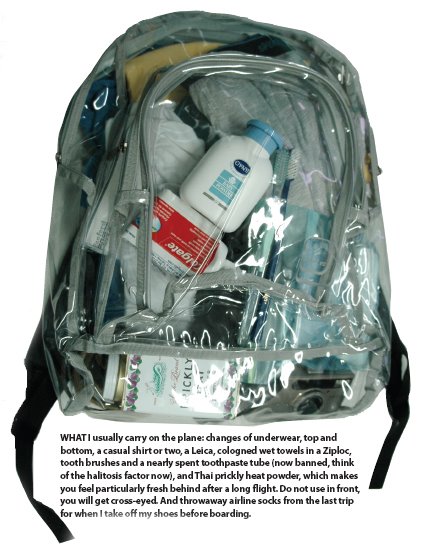
Teddyboy's clear plastic knapsack...'What I usually carry on the plane: changes of underwear, top and bottom, a casual shirt or two, a Leica, a cologned wet towels in a Ziploc, toothbrushes and a nearly spent toothpaste (now banned, think of the halitosis factor now), and Thai prickly heat powder, which makes you feel particularly fresh behind after a long flight. Do not use in front, you will get cross-yeed. And throway airline socks from the last trip for when I take off my shoes before boarding.'

By Teodoro Locsin Jr.

‘YOU are not alone,” my daughter told me one morning after we’d come back from a trip abroad where I was repeatedly ribbed on my unique and highly original knapsack. “Jean Paul Gaultier said in an interview that he was so sick and tired of being harassed at airports on his carry-on luggage that…”

“Don’t tell me,” I said.

“That’s right,” she said.

“That frog-eating s.o.b. I am not going to take being robbed by white people of my intellectual creations yet again,” I thundered. “Why I’ve had that clear plastic knapsack for six or seven years now and he talks like he was the first to discover it? I’ll sue him.”

Indeed, I am sick and tired of having American newspaper columnists steal my ideas and corporate giants exploit my discoveries without giving me credit, let alone royalties for them. For example, it was I who discovered and was the first to write about the “Fart Factor” in airline travel from both painful personal experience and acute and relentless observation.

My resistance had been so weakened from flying economy class on a plane full of unremittingly exhaling people that when I sat in the shade during a San Francisco Giants game, I succumbed to hepatitis. I concluded years later and well before it became an issue in airline safety that passengers had a curious tendency of leaning left or right or forward from their seats for no apparent reason and it struck me that they might be releasing air. And yet where was the fresh air? A jet must fly airtight and pressurized, so there can’t be an exhaust. In a famous column I wrote later I suggested farting straight into the cushion so the fibers absorb the stench.

At the same time, back on the ground, I also observed that I am a magnet for airport harassment and it’s been like that since long before 9/11. The only thing I haven’t been subjected to at airports is a cavity search and it doesn’t matter if I travel as an ordinary tourist or a state guest, like when I was detained at Detroit in the same room with plaited Jews and shabby Latvians for having been issued incomplete special travel documents by the US State Department as its Ninoy Aquino Fellow.

Was that any fault of mine, I didn’t issue the documents? And I had told them back in Manila that I already had a US tourist visa. But they insisted that I had to get special treatment. I had to fly to Washington, D.C., to retrieve my passport. And then there was the time when…you get my drift. So when I was browsing in a luggage shop in New York, which is what I most enjoy doing after bookstores, I saw this clear plastic knapsack and I thought, Why not come clean right at the start, right there at airport security? Let them see everything even without an x-ray. And so I’ve traveled since, years before 9/11, and the London airport scare.

The harassment, of course, continues because I am, as I said, a magnet for it even if I am whiter than most Americans, clean shaven like a baby’s bottom, and casually drop a big rosary along with my glasses in the x-ray tray. I dare anyone to say there is a light welt across my forehead that might have come from a towel wrapped around my head. Maybe my seeming transparency is arousing more suspicion that I am hiding something somewhere else.

And now Jean Paul is going to claim he thought of it first. I dare him to repeat his claim. I have patented my discovery and hereby copyright my latest observation that the next big airline safety issue will be halitosis, what with hardly any airline passing out travel kits with a small toothpaste tube to economy- class passengers who need it most.

(Originally published in the Business Mirror, Lifestyle Section, Sept. 25, 2006.)

September 22, 2006

Surviving infidelity

SOMETHING LIKE LIFE
Sept. 22, 2006

ONE of the most frequent areas of discussions I have with my friends regarding relationships is infidelity, adultery, or cheating on one’s spouse or lover.

Sometimes it would be just innocent gossip where we trade stories about how so and so celebrity is now making out with another actor other than his or her own usual partner (more often than not, also another celebrity). Remember how the rumor mill didn’t stop grinding out gossip about the turbulent relationship of Jennifer Aniston and Brad Pitt, after the latter was rumored to be enjoying the company of Angelina Jolie? Jennifer and Brad kept on denying they had problems and said things were fine in their marriage. Of course, the celebrity couple eventually split up and the acting-challenged Brad immediately shacked up with the talented Angelina, who was already pregnant with their baby, and adopted her Rainbow Coalition of kids as his own.

Then sometimes our gossip would revolve around our own friends, perhaps someone in our close circle whose spouse we have probably seen with another woman in public.

Moments like this can be depressing as we grapple with the question of whether we should tell our friend or not about it. Most often we just keep quiet, confident that our friend isn’t stupid and knows exactly what her husband is doing. This, however, doesn’t ease our discomfort from seeing something illicit and feeling like a traitor for not reporting what we’ve witnessed to our friend.

(My very wise married mader Marianne says that a husband and wife’s relationship is no one else’s business except their own. And as such, people outside the relationship should hold their tongue about allegations of adultery. I partly agree. Sure, who wants to be the bearer of bad news? However, if I were such an aggrieved party, I would appreciate honesty from my friends. I mean, who else can you count on to tell you the truth except your friends, right? In our desire to protect our ego, we sometimes delude ourselves that everything is still all right in our relationship with our significant other, despite our nagging suspicions. And sometimes only our friends can slap our faces really hard by telling us the truth.)

Infidelity strikes at the core of our very being. We all want to be loved exclusively by our significant other. We want to be the only one. Perhaps, human beings are really territorial by nature and such a code has been imprinted in our DNA and passed on to us from the days our ancestors lived in caves and hunted for food amid the preying dinosaurs. Our territorial feelings don’t just relate to material objects but people as well—our friends, lovers, family members, etc.

There is little risk when your cheater is just a boyfriend. You can break it off and walk away from the relationship, cry your heart out to friends who are only too willing to find a new man for you. If your boyfriend tries to get back with you, run in the opposite direction as fast as you can. Don’t be an idiot and fall all over again for his sweet words. I know, I know…it’s easier said than done.

But think about how more difficult it would be if you were married to the idiot and had kids with him? It would hurt immensely because you had been building a life together and, hey, “I thought we were happy….” After all, you had pledged to love each other—how does it go again?—“for richer, for poorer, in sickness or in health, ‘til death do you part”? Then here you are, finding out that he’s been messing around.

Maybe there was no sign at all that there was any problem in the marriage. So maybe you blame yourself for doing some unimaginable deed to have pushed your husband to stray. Or you blame the other woman for tempting your poor little defenseless husband. Rarely would wives think that the problem really is their horny husband.

You confront him about his cheating and he at first denies it. Then when caught again, he would probably say, “She doesn’t mean anything. I love you,” or some crap like that. Would you accept your husband’s explanations and stay together “for the sake of the children”? Or do you walk away and shut the miserable shit out of your life? Can you?

The growing number of women filing for annulments or legal separations, claiming their husband’s “psychological incapacity,” shows that Filipinas are no longer Maria Claras who will suffer in silence until their husbands wizen up.

Because the reality is, there is no assurance that your cheating husband will ever reform, despite his promises. I know a lot of men who’ve cheated on their wives, and even after they’ve been caught and given ultimatums by their wives, or threatened by their kids that they’d quit school if they did it again, they still go around hopping from one woman’s bed to another. Ick.

If you decide to stick it out in the marriage, how do you keep yourself from thinking that when he’s late he isn’t really in a meeting with his boss but probably romancing another woman? Once committed, adultery is like a dead child that parents can’t ever forget. It is intensely difficult to get over. With this hanging over your heads, there will always be an unpleasant and uncomfortable dynamic in your relationship with your husband.

But many wives still have their reasons for staying. I know one who spends her husband’s money like there was no tomorrow, just to get back at him. Another just keeps getting pregnant to make sure her cheating husband always comes home to her. Still another sticks with her husband to the end, through sickness, and until his death, accepting even his other wives, his other children.

No matter what path the wife takes to “cure” the situation, it will be strange and unfamiliar territory. And your only hope is that your ego will be able to handle it—and that you finally emerge stronger from the whole ordeal.

(My column Something Like Life, is published every Friday in the Business Mirror. Xavier Cortada, 'Adultery,' 36" x 36," Acrylic on canvas, 1995. From www.cortada.com)

September 15, 2006

Flashback!

TOP gossip columnist Cindy Adams of the New York Post today celebrates her 25th anniversary in the paper and reprinted her very first column. It was an interesting read not only because of the celebrity gossip but because it mentioned a very famous Filipino diplomat. Read on... (just remember this is circa 1981)

Current president of the Security Council, Carlos Romulo, age 82, knocked off another triumph. This week the U.N. awarded him its first Peace Medal in 36 years. Romulo said: "It's gold. Maybe I'll hock it."

Romulo's neighbor on the 36th floor of the Waldorf mystified him. The ominous note on the door read: "Keep out. Stay away. Don't anyone come in." Food trays were left in the corridor. Full wastebaskets were surreptitiously stashed in the hall. Wondering who the mystery president or security-logged chief of state was, Romulo inquired. It was Phyllis Diller.


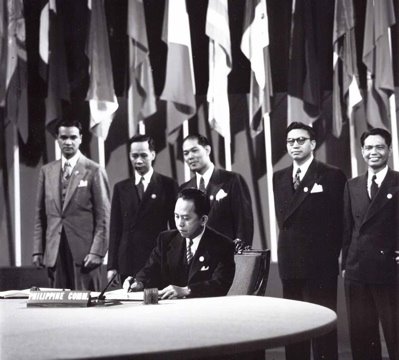
Imagine our very own CPR in the beginnings of one of the most succesful papers in the US! (A tabloid yes, but still very successful.) This was back in the day when Philippine diplomats were really astute and well-respected statesmen, not the common, garden variety species we have these days, whose only claim to fame is being well-connected with whoever is sitting in MalacaƱang. (At right, a much younger Romulo, signing the UN Charter on Jan. 26, 1945.)

Instead of being able to sell the Philippines to foreigners using brilliant marketing projects or smart networking with officials of the countries hosting them, most of our diplomats these days are quite content schmoozing in diplomatic parties and bringing home foreign cars tax-free. They usually only spring into action when they hear the MalacaƱang power traipsing through their neck of the woods.

Yes CPR, you were still the best we had.

(CPR excerpt from Cindy Adams' column in the New York Post, Sept. 15, 2006.)

------------------------------------------------------------------------------------
Almost forgot to post this...this note came from my newly-discovered pariente Choy Arnaldo (from Cavite now residing in Paris. My Arnaldo is from Roxas City, Capiz).

Stella,

Saw your blog on Romulo. Did you receive my note on this, on your blog, or did it get erased? (Sorry, didn't receive it Choy. The blog host acts funny sometimes.)

I was saying, if you look at the man behind Romulo to his left, you will see your uncle, Solomon V. Arnaldo; who was a member of the Philippine Delegation to UN and UNESCO to write both charters.

That's my dad! (Awesome!)

Choy

(see my blog: www.littlealmond.blogspot.com/)

Something Like Life

REMEMBERING GRANDPARENTS

IT was just Grandparents’ Day this past Sunday.

Yes, I know. There is such a celebration on the calendar apparently. Of course, like Valentine’s Day, Mother’s Day and Father’s Day, and the other sappy occasions not actually religious in nature, Grandparents’ Day was probably thought up by marketing geniuses to boost consumer sales in the lull before Thanksgiving and Christmas.

I only found out about it when my niece Nikka greeted my folks. My mom and dad were surprised as much as I about the existence of this special day.

Nikka, and her older sister Cesca, practically grew up around my parents. I remember when they were still toddlers, my siblings and I would notice how our parents were extraordinarily loving when it came to these two girls. There were lots of hugs, kisses and, of course, gifts. There was a time when I even got a little jealous of the special care and attention that Cesca, the first grandchild in the family, received. For the longest time, I was the baby of the family, being the youngest, and here comes along this young sprout taking away all the pasalubongs from me. Hmmph.

Of course, there is nothing that these creatures would do that would upset my folks. Even if they had done something bad—although this was very rare—they were and still are the grandparents’ little angels! Even though I’ve caught one of them lying a few times, my parents will choose to believe their precious grandchildren as innocent babes, never mind that they’re now in their 20s.

But I suppose things weren’t really all that different from my siblings and me either, in terms of our relationship with our own grandparents.

I for one so loooved my lolo. (Okay, truth to tell, he wasn’t my biological grandfather but actually the “special friend” of my grandmother. But we were close to his wife and family, too, so go figure.) Lolo Ƒing would come home to us almost every day, bringing with him lots of yummy treats—candies, chocolates, castaƱas. I remember playing in the street with my yaya, and as soon as I’d see him turn into our street, I’d rush out to meet him with a kiss and a warm embrace. And then reach into his paper bag of goodies.

The most vivid memory I have of Lolo Ƒing is him teaching me how to tell time. I would bring my pale blue plastic clock which had red arms and red buttons for numbers. Underneath the red buttons, which you could remove, were the minute numerals. So every day he would teach me how to read my plastic clock. Of course, I learned the darned thing in just a few days, but it was just so cool hanging out with my lolo that I extended my stupidity for about a week. He was probably thankful we weren’t really related by blood.

My Lola Ding, on the other hand, would come home with my favorite mamon or pianono from Quiapo. She would leave in the morning and then about after lunch, she would come home with bags of my favorite soft and delicious merienda treats.

For those who don’t know what a pianono is, it’s actually like a small roll with cream filling inside and cut up into six pieces of spiral goodness. Of course, as a small child, I thought my pianonos were the best thing ever invented on earth and would constantly nag my lola to buy me more. I don’t know if I would still find pianonos delicious now that I’m older and go gaga over foie gras. (Just an aside about kiddie tastes, when we were children, our favorite dinner treat was Mabuti sardines, which come from Portugal. They are packed in tomato sauce and come in yellow gold rectangular tins. The brand is still very much around but now cost over P100 a tin. Just to satisfy her need for some comfort food, my sister, now older and married, bought a tin and ate the entire contents. She told me later she couldn’t figure out why we loved it so much when we were little. Sigh.)

When I was in grade school, my lola would bring me lunch every day. Lola Ding was a genius in the kitchen (and thank God, we still have some of her recipes) but she was probably frustrated that my request was always fried pork chops and rice. And my banana, which I would eat as a side dish to my main course, instead of dessert.

Now that I think about them, I miss my lolo and lola. It was always just warm and fuzzy when they were around. They were there to listen to me make sumbong when I felt unjustly punished by my mom. Or someone had wronged me at school. I confessed my evil deeds to them, like pushing my playmate once in a pool of water. There would be no judgments, unlike parents. Just calm reassuring love.

Everyone who knew Lolo Ƒing and who thought we were actually related used to say I inherited my talent for writing from him, as he, too, was a journalist. I can only wish this were true. But I suppose in a way, he lives within me, or is probably around whispering in my ear a better lead for my story when I’m particularly stumped on how to write it.

As for my Lola Ding, every time I cook in the kitchen and whip up a new dish, I’m sure she’s right beside me watching and probably stopping my hand from dropping in any more salt than the dish needs. While she may not approve of some of the changes I’ve made to her Bacalao Ć  la Vizcaina recipe, I’m pretty sure she approves of it, albeit grudgingly.

So who needs Grandparents’ Day? I guess we all do.

(Published on Sept. 15, 2006. My column Something Like Life, is published every Friday in the Business Mirror.)

September 14, 2006

Sightings...at the Podium

HMMM...the presidentita GMA must be traveling light as she makes her way across Europe, Latin America and the Pacific this week. Seen watching the fashion show of Victorinox's newest luggage line last night at the Podium were business leaders Donald Dee and Miguel Varela, who usually travel with other prominent CEOs of the country's top businesses whenever GMA feels ambassadorial.

Asked why they were not with their presidentita, Varela's wife, Michelle, quickly spoke up, "Sa mga misis muna sila noh?", making everyone laugh. Dee's wife, a very luminous and young-looking Ophie, nodded and smiled in agreement. Ophie (short for Ophelia), mom of the equally beautiful former model Apples Aberin-Sadhwani, was one of the lucky winners of a Victorinox travel bag. Apples emceed the show with her proud husband, businessman Rajan Sadhwani, watching at the sidelines. Good thing he didn't win any prizes that night too or it would have been mighty suspicious. Hehe.

Anyway, Varela told us that they were indeed invited by their presidentita to join her trip but many of them declined because there were no business meetings scheduled on the sidelines of the quite longish trip which began on Sept. 9. He said the roundabout journey wasn't too encouraging either as it would take the delegation through a five-nation stop in Europe, then to Cuba before ending in Honolulu on Sept. 15.

Told that the UK Embassy in Manila issued about 120 visas for those in the presidential delegation, the very amiable Varela said, "Oo, lahat gusto pumunta ng London." He added, "They'll pay for their trip daw," though he turned away after making this remark. Hmmm... Varela, by the way, is virtually a member of the media, being the president of the Manila Bulletin. Plenty of hats, this man wears. :-)

Victorinox, the famous manufacturer of Swiss Army knives, watches and cutlery, offered a 20% discount to participants of last night's event. But we balked at the prices of its colorful double-stitched luggage which were selling for at least P15,000. The brand is definitely more expensive than Samsonite, but at those prices, you are definitely getting good quality products which conform to the latest international travel restrictions. Lightweight yet made of good strong materials, and with various compartments to ensure hassle-free packing. It's really the must-have travel gear for all.

(Victorinox is located at the second floor of the Podium, Ortigas Center, Pasig City.)

September 13, 2006

I love clean toilets!

Promoting Toilet Culture in a John Near You


(A public toilet in Hong Kong. Photo from FEHD of Kong)


EVERYONE loves a clean toilet, but does the idea of an exceptionally pristine potty make you want to burst into song? Officials at the WTO summit sure hope so.

And in case you were wondering, that's the World Toilet Organization. No joke.

Singapore's Jack Sim, self-proclaimed "representative of toilet culture" and head of the WTO, says his organization is serious about sanitary loos — and they're gung-ho about getting the rest of the world to buck up to the challenge of making public restrooms less revolting.

And as for the singing, part of the organization's campaign for clean cans involves promoting seemingly farfetched events — one such event being a WTO rock concert, the Associated Press reports.

"You cannot imagine singers singing about toilets and sanitation, but this will be done," Sim said.

According to the WTO, well-kept washrooms are not only a welcome sight to those answering nature's call, but also a key to integrating countries into the globalizing world. They even go as far as to say that festering public facilities can harm a nation's work force by causing people to … um … resist relief so long they could develop bladder and colon diseases.

"In fact, the toilet is the competitive edge of a nation," Sim said.

British Toilet Association chairman Sir William Lawrence seems to agree, noting that most complaints made to tourism organizations in his country are regarding restrooms — and that could potentially impair a nation's ability to attract recreational travelers.

"People seem to laugh a bit when I tell them I'm chairman of the (British) Toilet Association, but then ... they say 'wait a minute, there's a reason we need a toilet organization'," Lawrence said.

(Originally published on the Fox News web site, Sept. 11, 2006.)

September 11, 2006

Fighting silence

CULTURE VULTURE
By ROME JORGE
Sept. 11, 2006


SILENCE is the enemy of the poet, the painter, the musician and the actor. Artists attack the blank paper, the bare canvas, the silent studio and the empty stage, finding themselves insufferable foes.

As a writer, it is my life’s work to fight the silence. But I know that sooner or later, I will be overcome. Silence will be the death of me.

Silence kills. Without conversation, our monologue strays into presumption, paranoia and pride. We say the wrong things, if only to have something to say. Silence gives voice to our insecurities, our prejudices and our madness. It is a blindness with which we fall for the traps we ourselves made, collide with the walls we ourselves built, and wander away from our very salvation.

Silence begets silence. It is the attrition of fools. It is to answer that we are cowards not worth a response. Silence is suicide. It is to still one’s heart when another feels for a pulse.

I hate silence. But it is an implacable foe I have fought all my life. I know it well. The silent—all those who are unforgiving and unforgiven —are but part of a chorus that has ceaselessly sung the soundless litany of all that makes me unforgiving and unforgivable. So go on, as I myself will go on. I live for this fight.

"Lying is done with words and also with silence."—Adrienne Rich, feminist and poet

"We will remember not the words of our enemies, but the silence of our friends."—Martin Luther King Jr., pastor and civil rights martyr

"Experience teaches us that silence terrifies people the most."—Bob Dylan, folk singer and rock legend

"It’s so simple to be wise. Just think of something stupid to say and then don’t say it."—Sam Levenson, humorist and journalist.

(For the rest of the piece, click blog title. I specially dedicate this column to the Energy beat reporters and the Philippine Coast Guard.)

September 08, 2006

SOMETHING LIKE LIFE

Starting over

ONE of the toughest challenges men and women in relationships go through is coping or starting over when their spouse has passed away.

After years of what has become routine to you—going to bed with your newly showered wife beside you and waking up with her knee or elbow sticking to your side—it becomes a jarring experience when all of a sudden you find yourself alone in bed. There’s an empty space beside you, with her side permanently sunken and conformed to her shape. And instead of a soft silky arm or a warm breast to caress, your hand rests on the cold bedsheet.

Jeremy tells me when his wife passed away after a long illness, at least he had his two kids to attend to and keep his mind off his grief. Truly, children can save one from insanity and keep you focused on moving forward. There was no time for him to wallow in self-pity no matter how many times he wanted to surrender to the loneliness.

In the beginning, it was pretty tough even working around everyone’s schedules, including his. It was a good thing he had his sisters to count on to lend a hand in keeping his house in order. They brought the kids to school, picked them up, and stayed to cook dinner until Jeremy got home. They also pitched in to do the grocery, arranged what bills needed to be paid first, what school supplies the kids needed, etc.

But Jeremy says he knew he couldn’t depend on his sisters forever. They were both single and had their own lives to lead. And while their mom also helped out by staying with the kids or letting them come home to her house, Jeremy didn’t want to abuse her kindness. He was lucky that as a manager in the trading company he worked in, he was able to rework his schedule to fit his children’s.

It wasn’t going to be easy to run the household and put a new structure after eight years of a familiar routine basically set up by his wife Jane. Fortunately, technology was on his side. With cell phones and the Internet, it was easy for him to keep in touch with his staff and the company’s clients even while he was at home or attending a PTA meeting.

“I had to grapple pa with the extra duty of overseeing their assignments. Jane used to do all that, and she was really patient with them because she used to be a nursery teacher. No problem ’pag math but when it came to English composition, patay, I would call my sister [a writer] na.”

After tucking in the kids for the night, Jeremy still had to work on the stuff he brought home from the office. He confesses that, sometimes, he’s just so tired that he wants to give up and go to sleep. Thank God for coffee.

Then like a knife that would stab his heart, certain memories of Jane would just enter his consciousness. “Out of the blue. I’d be checking all the orders and then I’d remember her dressed in this blue and pink bathing suit that she wore when we went to Boracay. It was a year before she died. It was their staff outing and she brought me along. Ang sexy niya.

It starts with one memory, he says, then a whole tide would wash over him and he’d feel that dull pain gnawing at his insides. “Naiyak talaga ako,” he tells me quietly, as he remembers one particular night. Not far behind would be the feelings of guilt that he couldn’t take care of Jane very well, and then self-pity would kick in. Even when he was dead-tired from work and attending to his kids, Jeremy says sometimes he would just lay awake staring at the ceiling until he would hear the birds chirping outside the windowsill. “I was numb at first eh. Pero after a month, two, three months, wala na. It really hit me na she was gone.”

Jeremy says it took him a whole year before he could actually gather Jane’s things together and donate them to charity. His sisters wanted to do it for him but he realized that he had to look at Jane’s stuff again—sort through her clothes, her perfumes, her kikay things—if he wanted to move forward. He brought his kids to help, telling them they could take one thing that belonged to their mom to keep for themselves. “It was hard but we all needed to do that. All the while we were sorting her stuff nga, parang there was this internal dialogue going on in my head if it was the right thing to do or not.”

Somehow, he says, they managed to get through the ordeal without anyone breaking down. Jeremy says his kids are really tough, “something they got from Jane siguro. Kasi even throughout her illness, ang tibay n’ya.

It’s been three years since Jane’s death and the entire family has settled into its new routine. Jeremy has gotten a day maid to help out in the household chores. He is home by 6 pm in time for dinner with the kids. He monitors and helps in their homework but still calls his sister—for the English lessons. And he is dating again.

He says the funniest thing that happened after Jane passed away was his friends and his sisters jockeying to fix him up with this woman or that. Also, at his office the single women seem to have found an excuse to talk to him all the time. “Ewan ko ha, that’s what my friends told me. Kasi I didn’t really notice naman. But one would say, ‘O ayan na naman si…, magpapa-check ng inventory kunwari. I-date mo na kasi!’” It’s nice to hear such Jeremy’s hearty laugh. And he marvels, “Ang daming single women pala!

But Jeremy isn’t in a hurry to get married again, even if his friends tell him he should. He’s still young, that’s true, but he says right now he’s just enjoying the company of other women—that is, when his schedule permits. He says his kids are still the top priority, while going out with his barkada or dating remains at the bottom of the agenda.

He confesses that he still can’t help but compare his dates to Jane, which he knows is really unfair. This is but natural and quite understandable, I tell him. Besides, no woman in her right mind should even presume taking Jane’s place. But at least Jeremy has opened himself up to the experience of meeting other women, which is really a big step itself. He really can’t do much except take one day at a time and just enjoy the moment.

(Published in the Business Mirror, Sept. 8, 2006. My column, Something Like Life, is published every Friday.)

September 05, 2006

Top 10 relationship questions

YOU'RE dating a new hot guy, or currently in a steady relationship with a guy you think you’d like to spend the rest or your life with, or maybe you’ve just broken up with your boyfriend of five years. There are still a lot of questions keeping you up in the middle of the night. And no matter how many times you talk to your girlfriends or gayfriends, asking them the same questions over and over again (which they patiently answer over and over again because, hey, that’s what friends do), you can’t calm down. Your mind is reeling, you feel anxious, maybe even panicky, and you hope that the answers in your head are wrong.

Herein I think are the top 10 relationship questions that we women always torture ourselves (and our friends) with.

1. Is he going to call? Or should I call him?
The first date went well. You both clicked. And you’d like to see him again. Honey, if he doesn’t call, don’t take it too personally. He just may not be into a steady dating frame of mind yet, as I gathered from my talks with a lot of young men these days. Many of them are just trying to make a name for themselves in their chosen profession, so they’re not really in a hurry to tie themselves down to just one girl. Then again, he might just be looking for a different kind of girl and you don’t fit the bill. So it’s best to adopt the same attitude as men do and move on. Should you call him? Hell no!

2. Should I kiss on a first date?
If the date went well, a peck on the cheek would be nice before saying goodnight. But if you feel the chemistry really flowing, then you could consider some tongue action—but only if he makes the move first. You don’t want to scare him off, do you? Leave it at that and let him want to see you to get a taste of more.

3. Should I have sex on a first date?
It helps to be clear about your objectives for the guy. If you’re just in it for the fun of it, then be my guest. I realize that sometimes you just want to go with the momentum of a great date. But don’t expect him to say “I love you” after. More often than not, he won’t. No matter how many times you do it. Now if you strongly feel that he could be the father of your kids someday, then it would be best to hold back until you get to know each other better. Who knows, he might have insanity running in his family? Seriously, men like the chase. But whatever you decide, please practice safe sex.

4. Does he love me?
He’s nice and sweet to you. He’s thoughtful. Never fails to call you, always picks you up from your work, takes you out to dinners frequently, and showers you with lots of gifts. But not once has he said the “L” word. Honey, just in case you don’t know it yet, men are idiots when it comes to expressing their feelings. And they absolutely hate talking about the relationship, where it’s at or where it’s going, along with all the other stuff that’s important to you. I guess you will never know until he actually gets down on his knees and proposes to you. In the meantime, you could consider the truism that “actions speak louder than words” and be content basking in his undivided attention.

5. He’s asking for a cool-off period. Is it over?
If he wants to have a cool-off period, you know he is having doubts about spending any more time with you. It may not be over just yet but realize that it is heavily tilting toward that conclusion. In the meantime, go out with your friends and flirt with other men. Men are territorial
by nature, so if your boyfriend has any feelings for you left, knowing that other men are hitting on you could make him realize a thing or two.

6. Should you date during the cool-off period?
Absolutely! A lot of people may disagree with me but, hey, why should my girlfriend sit around and wait for her boyfriend to snap out of his stupidity? If he wants her, he knows where to find her. In the meantime, enjoy your freedom and go out. Moping and waiting for him to call won’t serve any useful purpose, except drive you crazy.

7. We broke up. I know he still loves me. Will we get back together?
You’ve been listening to Barry Manilow again? Heck no! Move on, girl!

8. How do I know he is The One?
Many married people I’ve talked to all agree that you will know if he’s The One. You’ll feel it in your bones, in your guts, in your loins and, most important, in you heart. Nothing stupid like “He completes me.” Because you should be a whole person to begin with. Like you’re already happy and satisfied with your life but having him around is a nice bonus.

9. He’s married but we’re very much in love. Is he going to leave her?
Not in a million years, honey! Especially if he has children with her. Either be content being a mistress and not complain if he isn’t with you always, or enjoy the fact that he isn’t with you always. Imagine all the wonderful things you could do—you’re in a steady relationship and yet you can go out and come home late, or have your friends over for dinner, go on vacations and so on. Enjoy your freedom. And, no, getting yourself pregnant won’t make him leave her either. He might just end up resenting you later for making him lose touch with his other children. Live your own independent life and just be there for him when he needs you.

10. He’s cheated on me but he says he’s sorry. Should I accept him back?
Tricky question. Maybe if it’s just once, stick to the relationship and give him another chance. We all make mistakes. Forgiveness is a huge part of making any relationship work. And if you’re married and have kids, there is more reason to stay together. I still believe that most kids grow up better adjusted when raised by two parents. Now if he’s a habitual cheater, then leave. He’s making you miserable, so stop being a doormat. “Hard” isn’t even close to describing what you will go through in the next few months, but just think about it this way: not many people get a second stab at happiness.

So live and love, people!

(Originally published in the Business Mirror, Something Like Life, May 19, 2006. My column comes out every Friday.)

September 01, 2006

Uniform cheats

By ALAN ROBLES
South China Morning Post


I'M thinking of switching careers - shifting to a job that will take me abroad and have employers crawling all over each other to bid for my services. Yes, I realise it might seem a bit late in the day to consider becoming a registered nurse, but only one thing worries me: what sort of uniform would I have to wear?

As for the rest of it, though, I'm very confident. That's because, as the latest scandal here shows, it's easy to pass the qualifying exams. All you need are perseverance, the proper attitude - and someone who'll hand you the questions before the test.

Why would anybody want to cheat in a nursing examination? That's easy: becoming a registered nurse is a guaranteed ticket to working overseas. The Philippines is among the world's biggest suppliers of nurses. Hospitals in many countries - mainly the United States - can't get enough of our nurses, and are snapping them up frantically. But there simply aren't enough to go around, which means the ones working in hospitals here are disappearing at an alarming rate.

I can imagine the scene in a Manila operating room. Surgeon: "Scalpel ... Nurse! I said give me the scalpel." Orderly: "She just left for the US."

So high is the demand that everybody is trying to get in on the act. Many doctors have started retraining as nurses. One computer institute opened a school of nursing, which has me wondering what kind of graduates it will turn out. If they become rattled, will they try to reboot their patients?

Now the whole enterprise is threatened by the revelation that, when 42,000 would-be nurses took the board exam in June, hundreds had been prepped with leaked copies of at least 500 of the questions.

There are accusations that the president of the Philippine Nurses Association (who has since resigned) leaked the questions to students he had coached. If that is true, it's an example of care and concern which his charges should never forget when they handle their patients. That is assuming they can tell one end of a patient from the other.

Although President Gloria Macapagal-Arroyo's spokesman has dismissed it as an "isolated incident", the scandal could scuttle a plan for the US National Council of State Boards of Nursing to hold licensing exams here.The spokesman probably knows that the head of the body giving the tests is the president's personal dentist.

Anyway, maybe the president (accused of cheating in the 2004 elections) can form a commission of lawyers (dogged by bar examination cheating in 2003) and doctors (still recovering from a medical board cheating scandal last decade) to investigate the case.

They could begin their work with a prayer: everybody should get down on their knees and thank the heavens that the Philippines doesn't certify nuclear power plant engineers.

(Click here for the South China Morning Post.)

Quote of the year

"(The Philippines is a) beautiful country with warm people. I will tell my friends to visit the Philippines because there are talented singers and dancers with the potential to become pop stars.”

Andrea Albert Pierre Casiraghi of Monaco

WHATEVER happened to "visit the Philippines because it has a lot of fabulous white beaches and fantastic shopping malls?" Well unfortunately for us, this royal—son of Princess Caroline of Hanover and commoner Stefano Casiraghi, and grandchild of that ethereal beauty, the late actress Grace Kelly, and her husband Prince Rainier of Monaco—he wasn't able to tour the beautiful spots in the country and instead got up close to the poverty and muck that is more the general rule around these parts, rather than the exception. (It didn't help that his visit commenced just as the oil spill in Guimaras was spreading its gloom and doom in the Visayas, while the government and Petron Corp. sat around doing absolutely nothing.)

Andrea came here as a follow up to his uncle Prince Albert and mother Princess Caroline's earlier visits, on behalf of Amade Mondiale founded by the late Princess Grace, which is a non-profit organization dedicated to protecting children's rights and uplifting their welfare. So necessarily, the 22-year-old royal cutie with blond shoulder-length wavy hair, had to visit the organization's projects in Sta. Ana and Payatas.

How he got the idea about our "talented singers and dancers", I confess I don't know. He must have watched Eat Bulaga or one of those inane variety shows playing out to a dedicated Filipino TV audience, while he was tucked away in the comforts of his luxe hotel room. Ugh.

Speaking of inane variety shows, is there any way our newly appointed Education Secretary Jesli Lapus can forbid public schools from visiting these noontime shows as part of their regular field trips? I remember when I was in grade school, we used to have lunch in Fort Santiago or Luneta. So it really floors me when you see a whole group of elementary school kids in their uniforms watching these shows along with their crazy teachers among the studio audience.

Oh I'm sure the teachers and principals of these public schools will justify these trips to TV studios as "educational" as the kids will see up close how TV shows are produced. Honey, we didn't do those until we were in high school and old enough to understand what TV production was all about! Obviously it's a way for the teachers to have some fun while at work. And you wonder why we have more artistas than we care to know? Most of them just pretty faces lacking in any real talent.

Go back to Fort Santiago kids, and learn why Rizal got shot in Luneta!