April 17, 2012

On leaving the comforts of home

(At Sitio de Amor, I had this lovely infinity pool all to myself!)

I COULD never understand why my father, when he was still alive, detested going on trips, no matter how near or short these were. He was the only person who I knew had never gone abroad, despite the many opportunities he had in his youth, according to Mama.

Toward the sunset of his life, he also got a bit prickly about motoring even just to go to my sister’s home down south, or going on vacation in Subic. I now understand why.

The older we get, the more it becomes a pain to pack a suitcase and leave the comforts of home.

Don’t get me wrong. I’ve always been excited to go off and visit new places and make new friends—I do have a mole on the heel of my right foot, which according to folklore means I’m prone to be layas. But, yes, sometimes it’s just a whole lot of trouble to plan what to wear, how many footwear to bring, and the sort of amenities one needs when one goes off on a trip.

Also letting go of the familiar sights and sounds of one’s home can throw off one’s vacation, no matter how lovely the destination one is in.

For instance, I have a quite a few family members and friends who simply can’t empty their bowels no matter how luxurious their bathroom is in their five-star accommodation. Heated toilet seat or not, the namamahay phenomenon afflicts a huge number of Pinoy travelers (no idea if it happens to foreigners too). I think there ought to be a scientific explanation for it, you know, like bangungot? I, on the other hand, am a wake-up-and-go kind of person, no matter what tourist destination, hotel, resort, or home I am in. Ugh. TMI.

(Mrs. Bondad prepared a hearty bulalo for lunch, among other yummy dishes!)

But I do harbor some basic standards in tourist accommodations.

Like the bathroom cannot be too far from my bed, otherwise it just f**ks up my sleep pattern. I drink a lot of water during the day, so I usually go to the bathroom at least two times at night, and most especially when the air conditioner is just blasting freezing winter.

So much to my regret, as I learned from a recent trip, I can no longer “rough it up” and sleep in a loft when the bathroom is miles away downstairs. It was just too damned difficult creeping around in the dark and padding around with only my socks on. (I didn’t want to wake my friends by switching on the stairwell light and wearing my sandals that could create noise as I crept down each step).

I also need at least three pillows for sleeping and a mildly thick blanket to keep me warm. So whenever I go on a roadtrip these days, I bring at least one pillow with me, as most hotels and resorts these days already provide a pair for each guest. (Why three pillows? One goes under the head, another under the back of my knees to support my bad back, and the last one rests on my neck to protect me from Dracula’s teeth. Blame this on the Christopher Lee retrospectives of my youth!)

I also confess to packing junk snacks, canned chicken Vienna sausages, and 250 ml cartons of soymilk in my suitcase, just to satiate the hunger pangs which may gnaw at my tummy after midnight. I’ve been to enough hotels with super-expensive or otherwise bleah-tasting food that don’t justify that room-service call. (And sometimes it’s just too much trouble to pick up the phone, say your order, and wait for 30 to 45 minutes for the dish you want. It’s so much faster to pop open a can of meat or tear open one’s favorite chichiria—talk about instant gratification.)

Then of course, I never go anywhere without my beloved soft-on-the-tushie three-ply toilet paper. I’ve just had too many unfortunate experiences in so-called luxury hotels and resorts that bust the bank for the best interiors, furniture and food, yet scrimp on TP. One-ply TP in a five-star international establishment is just...well, cheap. Not to mention unbearable.

(WIth love and care, the Bondads have managed to grow a number of lush trees, shrubs, and flowering plants on their property.)

If you think that’s weird, I know someone who brings her ratty blanket wherever she goes—yes, the same one she’s had as a child. And she is 50+! Oh and travel buddy Ms. RP doesn’t leave home without her iPod, the speaker, and a tiny nightlamp for her reading. She’s also the one I can usually persuade to squeeze the red wine bottle in her suitcase, hehehe.

Leaving one’s cozy home can be distressing. You can never be sure that the destination you’re traveling to would be equally restful and comfortable. And just the packing, then unpacking after you come home, can be a bitch.

Needless to say, I manage to compensate and overcome such distress by lugging around a huge suitcase with, yes, almost my entire house. And you wonder why I have a bad back. Tch.

* * * *

BUT stuff my suitcase I did when the gang and I went off to San Pablo, Laguna, for the Holy Weekend. We were there to watch the traditional Good Friday procession around the town plaza which features lavish carozas owned by some of the oldest families in San Pablo and in Tiaong, Quezon.

This was my second trip there, but this time I was staying in a different establishment. I found Sitio de Amor Farm Resort quite by accident, as I was Googling for other possible places to stay, as my go-to B&B was already fully booked that weekend.

The photos on Sitio’s web site looked interesting, and Miggy did say it had more “character” than another place we were considering. It was reasonably-priced as well.

Even if the resort did point out there was no Wi-Fi and TV, it didn’t matter so much since we were used to talking up a storm among ourselves. And, well, it was Holy Week after all; if we couldn’t abstain from eating meat, we could at least give up the TV, Facebook and Twitter.

Sitio de Amor is a 5-hectare property with only a few casitas, thus ensuring the privacy and quiet for its guests. We were served a sincere, home-cooked lunch consisting of bulalo, grilled blue marlin, ginataang langka, and sweet chicken marinated in soy sauce. It was such a hearty meal that had our tummies happily toiling away.
(Isn't it wonderful to just sit around and do nothing?)

While there were some issues with the fluctuating electricity which kept the air conditioners from running smoothly, and cobwebs in the ceiling of our bathroom, we had quite a pleasant stay. It has pocket spaces for meditation, a wonderful array of flora, and a few animals on the property. Oh, I couldn’t resist swimming in their lovely infinity pool, which I had all to myself! (Canned evil witch laughter here.)

The owners—Amor and Jorge Bondad—were ever so helpful and hospitable. The bright and cheery Mrs. Bondad was definitely the culinary expert and foodie, who even served up a seriously mouthwatering suman sa latik from Liliw for breakfast the next day. (Unfortunately, I couldn’t persuade her to part with some for me to take home, even if I did offer to pay for them.) I liked her the minute I spoke with her on the phone as I finalized our reservation.

Mr. Bondad regaled us with stories of how they had rehabilitated the property into the lush green gem it now is, far from the rather empty lot with logged-over coconut trees that it once was. Right now, he is rebuilding an old resthouse of Don Tomas Morato Sr. from Caluag right on the property, to serve as another guesthouse. Mr. Bondad is the inveterate “picker” who manages to discover really good finds among old houses, or what appear to be junk just by the roadside. They use all of these recovered items on their property.

So the upside of traveling away from the comforts of one’s home? It’s meeting fascinating, genuine people with loads of entertaining stories to share.

* Sitio de Amor is along Km. 88.8 Maharlika Highway, Barangay San Vicente, San Pablo, Laguna. For inquiries, visit www.sitiodeamor.com.

(This piece was originally published on April 13, 2012, in Something Like Life, my weekly column in the BusinessMirror. All rights reserved for these photos.)

April 14, 2012

ADB meet to help sell PH tourism

MANILA, Philippines- The country will have a chance to put its best tourism foot forward when the annual meeting of the board of governors of the Asian Development Bank is held on May 2-5 at the Philippine International Convention Center in Manila.

In a speech before the Makati Business Club Thursday, Tourism Secretary Ramon Jimenez announced that international news network CNN will do a series of features on the Philippines as it covers the prestigious economic meeting. The meeting is expected to attract some 4,000 participants from around the world.

“The country is hosting the ADB and we’re determined to make the most out of it. It is an opportunity to dramatize that the Philippines has turned the corner in more ways than one. So the CNN will cast an eye on the Philippines during the ADB meeting and will focus on the achievements of the Filipinos, and include tourism spots,” Jimenez asserted. (Read the rest of my piece in InterAksyon, the online news portal of TV5. My piece was originally published on March 29, 2012.)

Sun, sea, and a swell spa in Boracay

For sure, many of you are all revved up for your holiday in Boracay Island this Holy Weekend.

Let me share with you a little-known secret—where to get the best bang for your buck for a great massage, that is, after making your Lenten sacrifices on the beach.

SunSpa Boracay offers a wide array of rejuvenating spa treatments (ranging from Php750 for single treatments to Php2,000 for two-hour full pampering packages) that will help you meditate and reflect on your ahem, wicked ways, and yet be in a most relaxed state while you’re at it. (Click InterAksyon, the online news portal of TV, for the rest of my piece. This was originally published on April 3, 2012.)

Saigon—Remembering the past; celebrating the vibrant present

(Inside the Saigon Central Post Office - designed by Gustav Eiffel in the Gothic style.)

WHEN it comes to Saigon, one never knows quite where to begin.

Should I first write about the zipping motorbikes slowing down in the middle of the road as its riders try to quickly whip out their colorful raincoats as the monsoon rain starts pouring down?

Perhaps it should be the Pho, that ubiquitous noodle soup that is hearty and at the same time heartwarming, and yet uniformly tasting at any restaurant one goes.

Or what about the numerous memorials and museums to the Vietnam war, that deep-seated skirmish that Americans still can’t seem to forgive themselves for, and yet the Vietnamese seem to have already moved on from? (Read the rest of my piece and check out more of my photos in InterAksyon, the online news portal of TV5. My piece was originally published on March 29, 2012.)

Ayala unit boosts fresh water supply to Boracay

Boracay Island as seen from the air.

WITH thousands of holiday revelers expected to converge on the tiny resort island of Boracay this Holy Weekend, they can be assured of better access to clean, fresh water with the recent inauguration of a P126-million submarine water pipeline.

The 1-kilometer pipeline constructed by the Boracay Island Water Co., (BIWC) a subsidiary of the Manila Water Co. Inc., runs from Caticlan to Boracay, and will augment the current 13-year-old pipeline which supplies water tothe island from the mainland Malay town in Aklan.

Manila Water is a unit of the publicly-listedconglomerate Ayala Corp., and commonly known as the East Zone water concessionaire of Metro Manila.

During the inauguration ceremony for the pipeline on Friday, March 30, Tourism Secretary Ramon Jimenez Jr. lauded BIWC for the improved water services and wastewater management in Boracay since the company began operating there in 2009.

He said 96 percent of the island population on the island now enjoys round-the-clock water supply, with the quality of its tap water 100-percent compliant with the strict criteria set out by the Philippine National Standards for Drinking Water.

“I salute the partnership between Boracay Water, the local government and the [Tourism Infrastructure and Enterprise Zone Authority] for turning things around and making things happen here in Boracay. As the premier tourist destination in the country, we need to ensure that the basic services such as water and wastewater services for the locals as well as tourists are well-provided. This is also ensuring the sustainability of the island paradise for the years to come,” he said.

Tourism Secretary Ramon Jimenez inaugurates a P126-million, one-kilometer pipeline in Boracay on March 30. Also at the launch are (from left) Malay Mayor John Yap, Aklan Rep. Florencio Miraflores, Jimenez, DOT Region 6 Tourism Council chairman Vicky Ramos, TIEZA general manager Mark Lapid, Manila Water president and CEO Gerardo Ablaza Jr. and BIWC president Virgilio Rivera. (Photo from the Philippine Star)

The BIWC has been upgrading the wastewater management system of the island and hopes to reach its 52-percent target coverage by the end of the year from the current 31-percent coverage. The company’s P78-million project, inaugurated in April 2011, aims to improve the island’s treatment plant located in Barangay Balabag to a world-class facility, and ensure the treated wastewater being flushed back into natural waters is within the strictest environmental standards that will keep its beach pristine.

Last August, BIWC received a P500-million loan from the Development Bank of the Philippines and Security Bank and Trust Corp. to finance its capital expenditures for its projects in Boracay.

The loan, obtained through the Philippine Water Revolving Fund, has the option to be increased to P1 billion. The PWRF is a joint project between the national government, the United States Agency for International Development, and the Japan International Cooperation Agency. The fund was set up to help the country meet its own economic and human development targets under the Millennium Development Goals, a United Nations initiative, by 2015.

Boracay Island is the most popular tourist destination in the Philippines with 908,875 visiting in 2011, up 16.6 percent from 2010. In December 2011 alone, arrivals shot up by 34 percent from 2010 figures, generating P1.43 billion in tourism receipts for the government.

From only one airline serving the destination in 2006, now all major Philippine carriers as well as chartered international flights are bringing in local and foreign tourists direct to Kalibo, the capital of Aklan, or Caticlan, the jump-off point to Boracay.


Last year business tycoon Ramon Ang of San Miguel Corp. also funded the renovation of the Caticlan airport terminal, while its main runway is now being lengthened to accommodate jets.

Unfortunately, the hordes of tourists over the years have put a strain on the island’s fragile ecosystem. In 1997,the Department of Environment and Natural Resources declared the waters around unsafe for swimming as its tests yielded the dreaded E. coli bacteria, which is usually found in fecal matter.

This pushed the resort owners in Boracay to adopt stringent measures to help clean the island and prevent the contamination of its waters.

(My piece was originally published on April 3, 2012 in the BusinessMirror.)

If you want really good ice cream...


I’VE been thoroughly entertained lately by the nega-tweets and comments/status updates on Facebook regarding a newly launched ice cream bar that its advertising promises to make the one eating it feel like royalty.

Why so much hate, peeps? Or is this your way of expressing disgust at yourself for falling for the brand’s slick TV ad? Hahahay naku!

I won’t bore you with the details of the comments, but suffice to say that most who don’t like the supposedly sushal ice cream brand feel shortchanged. Poor kiddies, didn’t feel the royal spark at all. Seriously though, when you buy a P50 product, you don’t expect P150 quality, yes? Or do you? Sus.

I haven’t tried it myself, but even then I am not one who gets all flustered by grand advertising and hyped-up marketing campaigns especially those using celebrity endorsers. I’m sure I will get around to trying the bar sometime, but until then, here’s my list of current favorite ice cream products:

Fog City Creamery

Created by Edelyn Gamboa, and inspired by the artisanal ice creams in San Francisco where she used to live (thus, the brand “Fog City”), every spoonful is just luscious and exciting.

The sugar-free varieties are made with coconut sugar, said to have a low glycemic index and thus apropos for diabetics and those just trying to keep one’s blood sugar at safe levels. However, it leaves a slick of what appears to be coconut oil grease (sebo) on the backside of the spoon. Though unappealing in appearance, it isn’t exactly bothersome to those who love to lap up this ice cream which tastes oh-so-decadent, except that it’s actually healthy!

Of course, Fog City Creamery does have regular flavors which use sugar. The Salted Caramel is said to be its most popular, though I find it too sweet. Lucky you if you don’t have to worry about your sugar levels...you are in for an even greater treat. My all-time-favorite sugar-free variety is the Butterscotch Pecan. What’s cool is Fog City also makes seasonal flavors. Like last Halloween, it had a winsome Pumpkin Pie variant which was scary because I lapped up a pint in just a day. Boo!

The downside is, it’s difficult to buy unless you live in certain upscale cities where a delivery service is available. So I usually just wait for JJ Yulo’s foodfests at The Podium, which Edelyn usually participates in. But do check out Fog City’s Facebook page or www.fogcitycreamery.com on how to order.

Sebastian’s Ice Cream

This brand has been around since 2006 and is probably the original artisanal ice cream in Metro Manila. The first time I had a taste of the Chunky Mocha Almond Fudge, I almost dropped dead from sheer ecstasy. And by the way, that was a sugar-free variant! How can sugar-free ice cream taste this sinful, I wondered.

Though a bit on the sweet side, Sebastian’s spells rich and creamy, and uses huge globs of the finest ingredients. Like if you get the strawberry flavors (I forget now its actual title), you actually get huge chunks of the fruit. If you like Ben & Jerry’s, Sebastian’s is every bit as imaginative—I mean who can think of making our Filipino comfort food and delicacies like champorado and sapin-sapin into ice cream? Magaling!

Sebastian’s is readily available in malls like SM Mall of Asia, SM City The Block and TriNoma. Unfortunately for me though, my favorite sugar-free variety isn’t offered in all of its scooping stations. Waaah. By the way, it also has dive bars and ice cream burgers.

I’d recommend Sebastian’s hands-down for that impetuous snack break from shopping when at the mall. Or just bring home a half-gallon for the entire family to enjoy. The flavors are always amazing and unique.

Binggrae

Korean in origin, I like Binggrae’s unpretentious but witty take on ice cream.

Like the Samanco is just your basic vanilla ice cream in a waffle shaped like, well, a fish! And the surprise is, sandwiched between those layers of vanilla ice cream is red bean paste, so the contrast in textures is just a welcome delight.

Then a friend recently gave me a box of Binggrae iced popsicles which made me reminisce a bit for a local brand’s Twin Popsies of old, except these ones were creamier and full-flavored. Oh by the way, these are called Melonas but are actually strawberry-flavored, hahaha.

Curious, I Googled it and discovered that Binggrae is actually a 38-year-old company and is probably Korea’s most successful ice cream brand. It also makes yogurt products, fruit-flavored milk, and bottled coffee drinks. Oh and it also sells chichirias but I haven’t seen them in any of the local supermarkets yet.

Anyhoo, if there’s anything welcoming about the Korean invasion, it’s their ice cream products (and fine restaurants). Binggrae is available at SM, S&R and, I would assume, most local Korean supermarkets. Call Grace Lee to be sure.

(This piece was originally published on March 30, 2012, in Something Like Life, my weekly column in the BusinessMirror. Photos from company/product web sites, except for the latter.)

March 27, 2012

My favorite destinations in the Philippines

THE cool, powdery-white sands of Boracay.

The massive limestone cliffs in El Nido.

The clear, blue waters of Cebu.

The lush, rolling hills of Batanes.

The almost-perfect cone of majestic Mayon Volcano.

These are just some of the awe-inspiring sites to behold when traveling around the Philippines.

I’ve been fortunate to have traveled to quite a number of lovely places in the country primarily because of my profession, and due to a brief stint in the government in the early '90s, accompanying three successive Cabinet secretaries who frequently monitored their agency’s provincial projects.

Nothing compares to the beauty of the Philippines, simply because it offers a myriad of choices to travelers of all persuasions and budgets. And whether you’re a fellow Filipino or a foreigner, one can be sure of friendly locals at these tourist destinations, eager to help and ensure you have a great time.

Here are some of my favorite places in the country:

Albay

Mayon Volcano as seen from the Cagsawa Ruins.

THE still-active Mayon Volcano is one of the most moving and powerful sights I’ve ever been fortunate to behold in my life. Its near-perfect cone is simply breathtaking.

Aside from trekking to the volcano, you can also take an all-terrain vehicle straight up to the lava front. Other sites to visit are the Our Lady of the Gate Parish Church in Daraga that was built in the 18th century, the Cagsawa Ruins, Busay Falls, and LiƱgon Hills where an underground tunnel built by the Japanese forces can be found.

Of course, the best part about visiting Albay is eating spicy Bicolano dishes, such as Bicol Express, a variety of meats and fishes cooked with coconut milk, and my favorite dried fish called New Look.

Where to stay: Hotel Venezia (www.hotelvenezia.com.ph) if you’re staying in Legazpi City and want comfortable, clean and value-for-money accommodations. For a luxury feel, check out Misibis Bay Resort in Cagraray Island (www.misibisbay.com).

Batanes

A traditional Ivatan stone house in Basco, Batanes.

SOME foreigners have compared Batanes to Scotland because of its wide-open spaces, lush greenery and deep-plunging cliffs.

Take a trip to “Marlboro Country”—a rolling hill with horses and cows roaming around or feeding on the grass. Visit colorful old churches, such as the Basco Cathedral built in 1783, the Mahatao Church (1787), San Jose Church (1814), etc. And if you can take a seasickness-inducing boat ride to Sabtang (one of three major inhabited islands of Batanes), drop by Savidug, a village of traditional limestone houses still used by the locals (or Ivatans).

Where to stay: Batanes Resort is a 10-minute ride from the capital, and sits on a hill overlooking the sea. Built to resemble the Ivatan houses, the establishment is clean and inexpensive, with basic amenities, such as hot and cold water. They also serve local Ivatan cuisine where I got my first taste of fried flying fish—delish! (For inquiries and reservations, call 927-2393, 0927-5829078.)

Bohol

The tarsier is one of the more popular tourist attractions in Bohol. (Photo by www.nocturnal-animals.com/.)

ASIDE from the world-famous Chocolate Hills, the must-see places in Bohol are the 18th-century churches, such as the baroque-inspired Baclayon Church and Loboc Church, which has an extensive collection of images of various and other religious paraphernalia.

Have a hearty lunch of Boholano dishes while cruising down Loboc River, then visit the smallest primate in the world, the tarsier, in several of the minizoos located along the river.

Other activities include swimming on Alona beach, scuba-diving on Balicasag Island, and dolphin-watching on Pamilican Island.

I was recently told that my favorite resort no longer offers the best customer experience so better click www.bohol.ph/resorts.php for a list of accommodations.

Boracay Island, Aklan

Boracay - the all-time best beach in the country and one of the most popular in the world.

NO doubt the long stretch of white-sand beach and its clear turquoise waters are still the major reasons people continue to flock to Boracay.

Aside from the usual island tours, spa massages, food tripping and bar hopping, and banana-boat rides, there is an amazing number of fun activities that can also be pursued. There’s rolling down a hill in a zorb (www.facebook.com/zorbboracay), feeding the fish while helmet diving, and para-sailing, to name a few.

Visitors have a choice of resorts featuring the barest minimum amenities to the most luxurious, while foodies will surely enjoy an array of local and international cuisine cooked with the most authentic ingredients.

Where to stay: Discovery Shores in Station 1, if you want the best luxury accommodations with the friendliest staff to boot (www.discoveryshoresboracay.com); and Sun Villa in Station 2, for a quiet escape, the best value spa, and home-cooked cuisine (www.boracaysunresorts.com.ph/villa.htm).

Cebu

Visit the Taoist Temple in Cebu City, and make your petitions to the gods.

I HAVE loved Cebu since I started going there in the 1980s. One can be sure of warm, friendly smiles, an inexpensive but belly-busting meal, and just great entertainment because after all, isn’t this the land of country’s best singers? And, of course, the tasty, herb-filled Cebu lechon is simply one of the best-tasting in the country.

Some of the most interesting sites are the Shrine of Magellan’s Cross which was planted by the Portuguese explorer Ferdinand Magellan’s men upon his arrival in Cebu in 1521; the Basilica Minore del Sto. NiƱo where the oldest image of the Christ Child is enshrined; and the Taoist Temple, which is guarded by fierce dragons and where the local Chinese go to pray and seek favors from ancestors and ancient gods.

Also take a trip to Carcar, which is less than an hour drive from the city, which is famous for its chicharon, leather sandals, Spanish-era and American-period houses, and the historic St. Catherine’s Church, which is the second-oldest church in Cebu, after the Basilica Minore del Sto. NiƱo.

Where to stay: BE Resort in Mactan for its hip, cool interiors, beach and tasty restaurant dishes (www.beresorts.com); Islands Stay Hotel in Cebu City for a value-chic stay (www.islandsstay.com) accessible to major malls, offices and tourist sites in the city.

Davao

Dr. Bo Puentespina's 'bird talk' at the Malagos Garden Resort's interactive bird show. (Photo courtesy Malagos Garden Resort.)

DAVAO’S marketing slogan “From islands to highlands” says it all.

You will need boundless energy and at least a week to enjoy all the pleasurable offerings of this region.

Climb Mount Apo and catch the sun breaking through the clouds; visit the mighty but endangered Philippine eagle at the Philippine Eagle Center; watch an entertaining interactive bird show at the Malagos Garden Resort; see the creepy bat cave on Samal island; or go ziplining in what is reputed to be Asia’s longest, which is definitely not for the faint-hearted.

Eating durian can be a challenge to first-time visitors—it tastes like heaven but smells like hell, goes a local saying—so if the smell is off-putting, you can try its other variants like candies, coffee (at the homegrown Blu Gre cafĆ©), or ice cream (Donnabelle brand). Other than durian, pomelo and mangosteen are also plentiful and readily available in the market, supermarkets, and roadside fruit stands.

One of the remarkable food finds in Davao is the artisanal goat cheeses under the brand of Malagos Farms which are comparable in texture and taste to the foreign brands.

Where to stay: Marco Polo Hotel (www.marcopolohotels.com) is still the finest hotel in the city with its large comfortable rooms, and possibly the best Chinese restaurant in the area.

Palawan

Massive limestone cliffs dot the clear torquoise waters of El Nido, Palawan. (Photo from www.e-philippines.com.ph.)

ONE of my most memorable trips has got to be in El Nido, in northern Palawan.

Take a pump-boat ride and marvel at the colossal limestone cliffs or swim in the clean waters of Bacuit Bay where you can see schools of colorful fishes and other marine life. Or why not stop by a sandbar and enjoy the cold powder-fine, white sand under your feet?

Where to stay: Miniloc Island Resort (www.elnidoresorts.com) is in itself a tourist attraction, with its lush surroundings and water cottages built on stilts.

A must-see in Palawan is the Puerto Princesa Underground River, which has been gaining a massive amount of publicity since it was named one of the New Seven Wonders of Nature. The main attraction is the St. Paul’s underground cave where stalactites and stalagmites have formed over the years.

Where to stay: Hotel Fleuris in Puerto Princesa (www.fleuris.com) loves hosting groups—whether families or friends, so make sure you avail yourself of its barkada package.

By no means is this list complete. There are so many other gorgeous places to visit in the Philippines, and where travelers are assured of warm smiles and fun times.

(This piece was originally published in the BusinessMirror, Feb. 26, 2012. All photos by this blogger, unless otherwise specified. All rights reserved.)

March 26, 2012

Festivals of the Odd

Taong Putik festival in Nueva Ecija. (Photo by Bullit Marquez/AP via Daily Telegraph)

It’s definitely more fun in the Philippines—to quote the Department of Tourism’s new marketing slogan—because the country is always alive with the many festivals going on in some part of the country somewhere.

Most fiestas are still steeped in the Catholic tradition—celebrations of a city or province’s good fortune believed to be accorded by a patron saint. Then there is the devotion to the Virgin Mary in all her incarnations, and her son the Baby Jesus or Santo NiƱo, like the Sinulog festival in Cebu and the Ati-Atihan festival in Aklan, both of which will culminate today. Also worth mentioning is the grand annual celebration of Tondo, Manila, fiesta also to Santo NiƱo.

There are also the festivals that celebrate a town’s founding anniversary, or its native products.

Whatever the basis for the merrymaking, you can bet on a lot of food served, overflowing drinks, much singing and dancing, and contests in all shapes and forms. Costumes and parades are also de rigueur for a number of the festivals as well.

But there are a few festivals in the country, which are still not too well known by the majority, and have odd or unusual beginnings.

Just monkeying around

Down South, in Surigao del Norte, the municipality of Malimono pays homage to human-sized monkeys said to have existed in the coastal area even before the time of the Spaniards, by celebrating the Onggoyan Festival.

In fact “Malimono” got its name from the mischief and mayhem caused by the monkeys. Legend has it that the monkeys (“unggoy”), seeing human beings perhaps for the first time, plotted and stole the food and personal belongings of a group of Spanish travelers when night fell. The next morning, finding themselves bereft of belongings, the leader of the group cried “mal mono” (bad monkeys) in disgust.

The natives, however, thought the monkeys were gods, according to the Provincial Tourism Office. So every May 15, the residents of Malimono make offerings to these monkey gods by preparing their favorite foods like bananas, cassava, etc., in the hope that the mischievous ones leave the residents alone.

While the festival is held intermittently due to scant financial resources, when the event is mounted, people go around dressed up as monkeys, and play tricks on neighbors. Tricks are played by one family on their neighbor, there is a lot of singing and dancing, and people tell stories or mount plays based on the lives of the monkey gods.

Local products are also on display during this festival, as street dancers go around imitating the movements of monkeys.

Mudfest

If Surigao del Norte has its mischievous monkeys, Nueva Ecija has its mud people.

Every June 24, Catholics in the country observe the feast day of Saint John the Baptist. Many barangays nationwide, especially those named after the saint, celebrate the feast by dousing their neighbors and passersby with water.

In Barangay Bibiclat, in the town of Aliaga, Nueva Ecija, the feast day of the baptizing saint takes on a different color as devotees literally transform themselves into mud people or “taong putik.” Residents call the ritual “Pagsa-San Juan” (Imitating St. John), while outsiders have dubbed it the “Taong Putik Festival.”

Devotees, because of their panata or vow to the saint, or perhaps as a way of thanking him for blessings received, smear their entire bodies with mud, and then wrap themselves in banana leaves, tied end to end, to make sure their identities are kept secret. They then go around, knocking on doors to beg for candles or money to buy candles to be offered to the saint during the Mass at church. After the Mass, everyone removes the banana leaves to reveal himself or herself and participate in the procession in honor of the saint.

Healers gather in Siquijor during Holy Week to make their 'magic' potions. (Photo from MySariSari Store)

The residents, even old timers, don’t know exactly when the festival began. They believe it started as early 1876. According to some, early Ilocano settlers brought an image of St. John the Baptist to Bibiclat, which helped rid the area of poisonous snakes. “Biclat” is actually Ilocano for “snake.”

Others say the ritual started in World War II when Japanese soldiers wanted to take revenge on the village whose residents they thought killed fellow soldiers. As the Japanese soldiers were about to execute all the males in the village, it rained so hard that the prisoners had to be brought into the church. Supposedly, the Japanese soldiers had a change of heart and freed the men instead. The village attributed this miracle to their patron saint. Thereafter, the villagers vowed to celebrate his feast day by wearing costumes patterned after the saint’s, but using native materials like banana leaves.

Witches’ brew

Every Black Saturday, “witches” from all over the country descend on Barangay San Antonio in Siquijor, Siquijor, for a grand meeting.

What people believe as witches, however, are really herbalists, locally known as albularios, who come from all over the Visayas and Mindanao to recharge their healing powers. They usually gather at Crocodile Hill, overlooking the Bay of Lazi and Mindanao Sea.

According to those who have been able to witness the ritual, these healers merely throw in tree barks, herbs, insects, roots of certain crops, into a giant vat of coconut oil, roiling to a boil over fire. Participants in this annual “Witches Festival” invoke the spirits and other mystical forces by saying ritualistic verses in a rhythmic monotone believed to energize the brew and give its handlers the power to heal. The “witches” then dip their flasks or containers into the brew to take home and use in their treatment of the ill.

Siquijanons say the ritual takes place during Black Saturday because this is the time Jesus Christ has yet to rise from the dead and thus, supernatural forces are able to go about freely and share their gifts of healing with humans.

Due to Siquijor’s relative isolation from the rest of the Visayas and Mindanao, and perhaps due to their level of education, the locals still believe in mananambals (herbalists) or mangbabarangs (black witches). As such, the festival has taken on an occult or mystic feel. But festival participants insist they are nothing more than ordinary people given the gift to heal.

Flying pests

El Nido, Palawan, is well known for its bird’s nests prized in Chinese cuisine, as well as its diverse marine ecosystem. But it is also famous for its high incidence of malaria cases.

To kick off an anti-malaria campaign, the El Nido Foundation mounted the very first Pista ng Kulambo (Feast of Mosquito Nets) in 1999. Since then, the festival is held every first or second week of December, and serves as the culminating activity for the year for the town.

The foundation believes that the festival helps reinforce malaria awareness and encourage people to use “impregnated” mosquito nets. That means that the mosquito nets are immersed in insecticide and air dried before being put to use. While there are medicines to protect or treat people ill with malaria, these are usually expensive. The cheaper alternative is to use mosquito nets to prevent from being bitten by these nasty flying insects.

Organizers of the festival usually come up with a lot of gimmicks to enable the residents of the 18 villages in El Nido to use their mosquito nets creatively. There have been contests on the best-dressed in a mosquito net, the biggest net, or the smallest net, etc.

Aside from bringing out the creativity of the residents of El Nido, the annual festival has enabled the town to dramatically reduce its malaria cases by over 80 percent since it was first held in 1999. Now isn’t that a good reason to celebrate?

Residents of El Nido, Palawan parade in their mosquito nets in their annual Pista ng Kulambo. (Photo by Mon Corpuz via Flickriver.)

Where the laundrywoman is actually…a man

But one doesn’t have to go far into the provinces to see unusual festivals.

Mandaluyong City, for example, has its own feast of the odd—a Lavandero Festival.

Conceptualized to celebrate the city’s foundation and liberation day, the festival is usually the highlight of weeklong activities held from February 1 to 9. (But there are times the festival is also held in November.)

The City Administrator’s Office created the festival in 2000 celebrating a traditional means of livelihood in old Mandaluyong during the Spanish era and right until after World War II. This was when Pasig River was still clean and teeming with fish.

“Mandaluyong was known for its men who supported their families while washing clothes. Many of them were able to send their children to college by being laundrymen. In fact two of Mandaluyong’s mayors used to be laundrymen—Pedro P. Cruz in the 1940s and Isaac Lopez in the mid-’50s. And I found out that the men’s way of washing clothes is very much different from the women. Hinahataw nila sa bato, tapos pinipilipit. [They whip it against the rocks or stones by the banks of the Pasig River then twist it],” says Jeffrey Sison, who first mounted this festival. Women, on the other hand, wash clothes by rubbing the front of their fists against each other, then wringing the water out.

“An oldtimer told me during the course of my research that before, being a laundryman was considered ‘macho’ [unlike now when it is seen as being ‘under the saya’]. Besides it was only the men who had enough strength to wash heavy garments then like blankets, the sotanas of the priests, etc.”

During the Lavandero Festival, male residents dress up in a typical washerwoman’s attire, a red or maroon patadyong with a white hand towel wrapped around their head. Imagine the delight of onlookers to watch these macho men dancing during the parade carrying a washbasin and a wooden palo-palo!

Exciting contests and shows are held by the banks of the Pasig River as part of the festivities.

As in most festivals, even these odd ones are celebrated with typical Filipino charm, humor and creativity.

(For a list of Philippine festivals, click on the Department of Tourism web site. This piece was originally published in the BusinessMirror on Jan. 15, 2012.)

The stuff champions are made of

Trekking the craggy boulders of Mt. Apo. (Photo by Rhonson Ng)

EVEN as a child, champion racer/mountaineer Jonathan Pido constantly tried to outdo himself.

A native of Carmen, Davao del Norte, Pido came from humble beginnings—the son of a farmer, Pedro Pido (now deceased), and Vivien, a food vendor.

He said when he was in grade school, he would help out in his father’s farm planting rice, bananas and vegetables. “Pero nu’ng namatay s’ya, bumalik na ulit sa may-ari ’yung lupa. Tenant lang ang papa ko. Ang mama ko, nagtitinda ng banana cue, barbecue, nagbabalot ng ulam.”

Pido, a police officer by profession, was the grand-prize winner of the 1st International Mt. Apo Boulder Face Challenge held last year in Sta. Cruz, Davao del Sur. He, along with his team mates Angelito Sibayan and Edwin Bueno (Team Carmen), bested 18 local and foreign teams, and clocked in at 22 hours, 51 minutes, and 42 seconds. The team won $3,500 (about P154,000) and a trophy for its effort.

I met him at the recent press briefing to announce the 2nd International Boulder Face Challenge, which will be held on April 28 and 29. With neither “hiking” nor “mountain climbing” in my vocabulary, I wanted to discover for myself the stuff champion racers/mountaineers were made of.

The second to the last child in a brood of 12, Pido said when his father passed away, “naghiwalay-hiwalay na kami.” Some of his siblings went to find work in Manila, some went abroad, while he and a few others stuck close to home. All the siblings, he said, now help out to support their widowed mother.

Despite the family’s financial circumstances, Pido wasdetermined to continue his education and graduate from a university, hoping to become a soldier or a police officer. He said he was inspired by his relatives who were in the Philippine Army and in the police force. “I was attracted to their keen sense of leadership, and their self-discipline,” he explained in the vernacular.

To support himself in his studies, he worked in a banana plantation tending to the flowering plants, then as a bagger wrapping huge plastic bags around the fruit bunches. “It’s backbreaking work,” said Pido half-chuckling and wincing at the memory. He said he had to wake up at 4 am to be at the plantation by 6 am for “assembly time”, and work continued until 2 pm, just as the sun was shining at its mightiest. By 4:30 pm, he was off to school where classes lasted until 9:30 pm.

Amid his hectic work and school schedules, Pido said he still managed to find time to join school clubs, become an officer in the Student Council, and even help in the local Kiwanis chapter.

In college, he joined the varsity volleyball team to help defray his tuition. His hard work and focus on his professional goal paid off. Armed with a Bachelor of Science degree in Education from the University of Mindanao-Panabo College, he applied at the Philippine National Police and passed its entrance exam in 2009.

Pido has been a cop for three years now. As P01 with the Regional Public Safety Battalion, 2nd Maneuvering Company of the PNP Region 11 Command, Pido helps beef up the checkpoints in Davao to ensure that the city and its surrounding environs are always safe from criminal elements.

Taking part in extreme sports or activities appears to be second nature to Pido, now 28, having faced adversity most of his life. He runs to keep fit but also takes part in running competitions and marathons. (Last December, he also ruled the Century Properties Ultra Marathon in Manila.)

He said he took up mountaineering in 2007 and first climbed Mount Apo with newfound friends from the Panabo Eco-Adventures and Keepers. “Matagal ko ng gusto mag-mountain climbing, at umakyat ng Mount Apo,” he said. “Why?” I asked. “Wala lang, out of curiosity,” he answered. But I sensed it was probably due to a desire to again challenge himself with some new activity.

It’s easy to comprehend why Mount Apo holds an immense allure for mountaineers and other extreme sports enthusiasts. At close to 10,000 feet, it is the highest point in the Philippines. According to pinoymountaineer.com, the still active volcano “possesses a formidable array of landscapes, from craggy rockscapes to virgin forests; from mossy swamps to volcanic structures,” thus offering “the widest spectrum of environments” for climbers.

Despite their relative expertise in climbing Mount Apo, Pido and his teammates still faced quite a few formidable challenges during the race. One was the sulfur emissions from the volcano—they didn’t have masks to protect themselves from the fumes. And second was battling hypothermia.

Pido said the team reached the peak at 10 pm, or 12 hours after they had set off from the Municipal Plaza in Sta. Cruz, the starting point of the race.
By then, he said, the temperature at the summit was freezing and they were garbed only in singlets (sleeveless running shirts), their shorts, and running shoes. “Wala kaming pang-ginaw,” he said. Fortunately, they stumbled on cellophane bags which they used to wrap themselves with and keep warm.

Because it was a race, there were no breaks except at the designated checkpoints, and to eat their meals. “Ang baon namin pork adobo at kanin, at saka mga energy bars. Kailangan mo talaga ng kanin para sa carbo-loading, para me energy ka umakyat,” Pido explained.

According to Art Boncato, regional director of the Department of Tourism Region 11 (Davao Region), the Boulder Face Challenge was first held in 2008, but in 2011, they decided to encourage international teams to attend as well.

“The Mount Apo Boulder Face Challenge is one of the toughest adventure races in the Philippines,” he said. “It is a 24-hour extreme challenge using various disciplines such as mountain biking, trekking, water tubing and road running. The race starts from the Sta. Cruz beach lines and participants will navigate through the town’s tough trails and raging rivers, scale the boulder face of Mt. Apo, and culminate in the skyline of the country’s highest mountain.”

The event is one of the highlights of the annual Pista sa Kinaiyahan (Feast of the Environment) of the municipality of Sta. Cruz. Boncato said the annual competition has made the region of Davao a leading destination for eco-adventure tourism. It has also helped increase awareness about the importance of protecting the environment. This year, organizers expect participants to reach the maximum 35 teams—each team consisting of two racers and one logistical crew.

Declared a national park in 1936 and a protected area in 2004, Mount Apo is home to the Philippine eagle, and hundreds of other critically threatened bird and plant species. The national park is on the tentative list of Unescoas a World Heritage Site.

Despite the handicaps, and competing against better-prepared international racers and climbers, it’s amazing how Pido and his teammates still managed to snag the top prize last year. Asked what he did to his share of the prize money, he said with a hint of pride, “Bumili ako ng lupa, one hectare lang. Ginawa kong sagingan.”

Still unmarried (“Gusto ko muna makapag-invest para ‘pag panahon na, at least handa na ako.”), Pido said he intends to join this year’s challenge and is quite focused on winning again. And maybe someday, he said, he’ll make it to the top of Mount Everest as well.

To join the 2nd International Mount Apo Boulder Face Challenge, register online at www.boulderface.com.

In lower photo, P01 Jonathan Pido, left, and teammate Angelito Sibayan cross the finish line in the 1st International Mt. Apo Boulder Face Challenge in April 2011. The Department of Tourism Region 11 has announced the 2nd International Mt. Apo Boulder Face Challenge, which is scheduled on April 28 and 29 at Sta. Cruz, Davao del Sur.(Photo courtesy www.boulderface.com)

(My column, Something Like Life, is usually published every Friday in the Life section of the BusinessMirror. This piece was originally published on Feb. 10, 2012. Yes, I've remiss in my posts. Wah.)

February 20, 2012

4M tourists found the PHL ‘fun’ in 2011

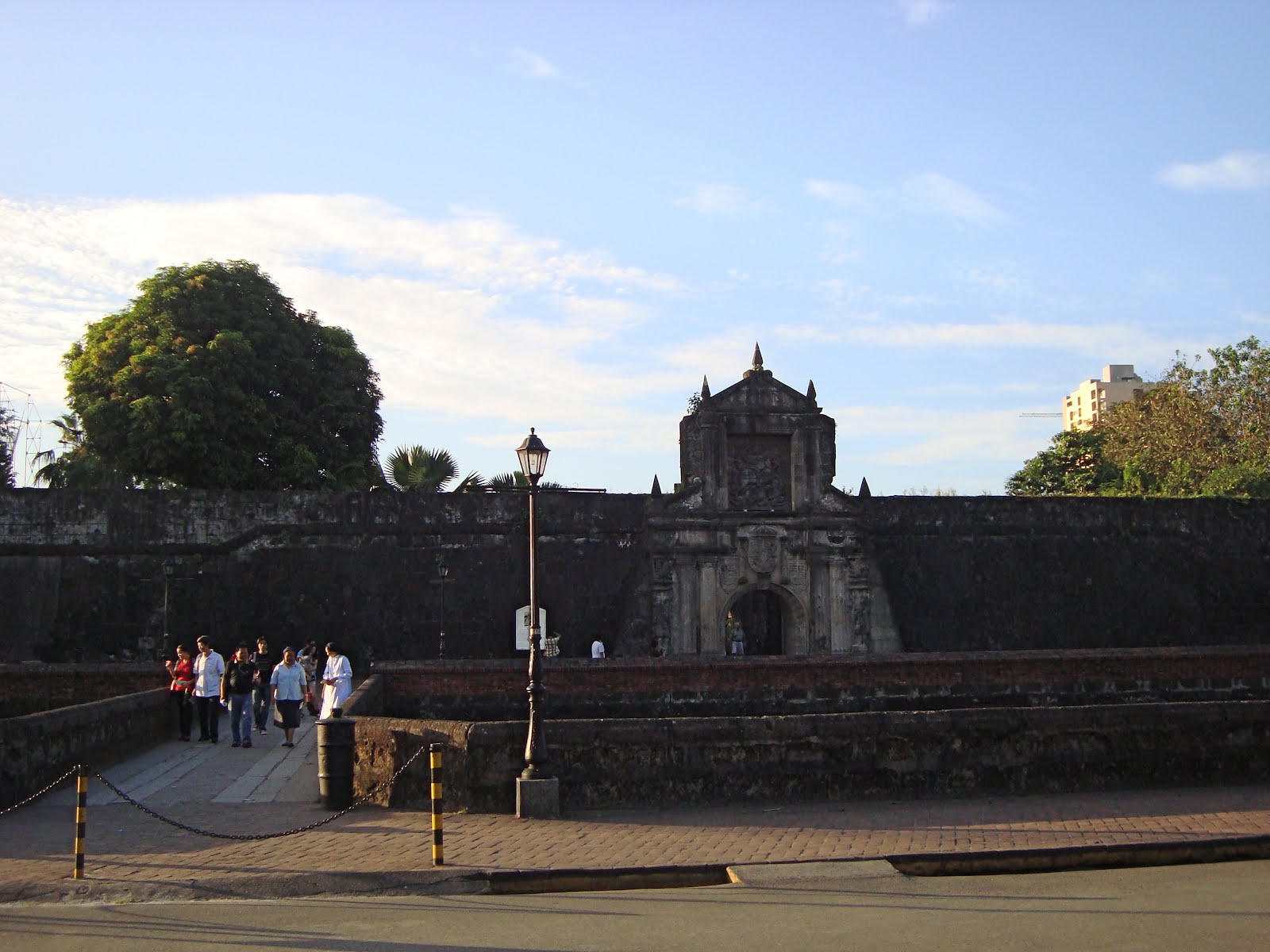
(The main gate to Fort Santiago in Intramuros, a popular tourist site in Manila and the seat of government during the Spanish period. National hero Jose Rizal was imprisoned at the fort, which now displays various Rizal memorabilia.)

CLOSE to 4 million tourists apparently found the Philippines “fun” in 2011, with the bulk coming from three major markets—Korea, the United States and Japan.

The Department of Tourism said this surpassed its 3.7-million target for that year, and was higher by 12 percent than the 3.5 million who arrived in 2010.

“When the industry exceeds expectations as it had done last year, we feel very encouraged. And with the overwhelming response to our new brand campaign launched last month, we know that we have broken ground on crowdsourcing. The people’s campaign will help bring more numbers,” said Tourism Secretary Ramon Jimenez Jr. in a statement.

The DOT launched its “It’s more fun in the Philippines” brand campaign in January, using social networking as its platform. By April this year, it will roll out its actual campaign using traditional media such as television commercials, billboards and posters, targeting major target markets in North America, Europe, Asia and the Middle East.

Jimenez expressed confidence that another record-breaking year will be achieved in 2012 once the new brand campaign is fully implemented. “Our marketing resource has grown exponentially because of other people’s contributions in kind. We will continue to build on these positive energies to attract 4.2 million this year.”

As a regional group, East Asia accounted for almost 47 percent or 1.84 million of the visitors in 2011. December proved to be the strongest month for tourists with 394,567 recorded.

The country’s top 10 markets in 2011 were: Korea with 925,204 arrivals representing 23.6 percent of the market share; US at 624,527 (15.9 percent); Japan 375,496 (9.6 percent); China 243,137 (6.2 percent); Taiwan 181,738 (4.6 percent); Australia 170,736 (4.4 percent); Singapore 137,802 (3.5 percent); Canada 117,423 (3 percent); Hong Kong 112,106 (2.9 percent); and the United Kingdom 104,466 (2.7 percent). (See attached Scribd document at the end of story.)

(Aileen Clemente, president of the Philippine Travel Agencies Association)

Meanwhile, a travel executive said it will take more than a slogan to sell the country to tourists, but was hopeful the DOT would hit its arrivals target this year.

“There was a launch of a slogan, but this is not yet the strategy and campaign. No logo guide has yet been released, etc. We are waiting for these for implementation. I believe the tourism arrival targets can be achieved but it takes more than the tagline. This includes policy reforms [visa procurement etc.], infrastructure development, capacity to take tourists, etc. But I believe that if we want to achieve something, we are able to achieve it. So I am very hopeful,” said Aileen Clemente, president of Rajah Travel Corp. in an interview with the BusinessMirror.

Clemente, who is also president of the Philippine Travel Agencies Association, said traditional destinations such as Cebu, Bohol, Palawan, Davao, North Luzon and the Metro areas will still get bulk of the visitors this year. She attributed this to the better infrastructure in these areas.

“But there are other locales that are aggressive in tourism such as Legaspi, Marinduque, Aurora, Camarines Sur,” she noted.

Clemente added that Filipinos will be traveling more this year as low-cost carriers continue to offer affordable fares and new destinations within the country and to nearby regional destinations.

“I predict that Filipinos will increase their travels both within [the country] and outbound. There are more LCCs now which makes it relatively cheaper to travel around and out of the country and into more routes than in previous years,” she said.

The strong peso will also likely be a boon for travelers going abroad, she added.

Clemente disclosed that regional carriers will be slashing their fares by as much as 50 percent to be able to offer more affordable travel packages to visitors of the 19th Travel and Tour Expo from February 17 to 19 at the SMX Convention Center in Pasay City. (UPDATE: Philippine Airlines said it actually slashed its fares by as much as 70 percent.)

In a press briefing, she said: “We have a range of airlines participating in the travel fair from low-cost carriers to major carriers which will be giving the best value for your money.” She said long-haul carriers will be offering discounts from 10 percent to 20 percent.

The three-day event is expected to exceed last year’s more than 60,000 visitors from around the Philippines with over 450 booths featuring some 200 local and international organizations including travel agencies, airline companies, cruise operators, domestic tour operations, government agencies, embassies, national tourism organizations, hotels and resorts, international tour operators, travel shops and more, she said.

The travel fair with its theme “One Stop Shop to the World,” is co-organized with the DOT.

Clemente said the fair is seen generating P330 million in sales revenue, or “at least 10 percent higher” than sales recorded in 2010.

She noted that there were several new exciting destinations to be showcased at the travel fair, such as Hokkaido, one of those usually overlooked by frequent visitors to Japan. Most travelers to Japan, she said, would go to Osaka, Narita and Nagoya.

“Also, India is a newly launched route for PAL [Philippine Airlines] so we’re trying to intensify the promotion for that,” she added, even as both Indian and Philippine governments were working to ease the visa procedures in both countries.

Clemente also noted new destinations such as Legoland in Malaysia, as well as activities like “river cruising” in Europe and in Asia, as travel possibilities for Filipinos.

The annual Travel Tour Expo of the PTAA was conceptualized in 1994 to showcase the products and services of its members. Since then it has grown to be the ultimate destination for the most affordable travel deals and the prime marketplace for all destinations.

The expo is open to the public from 10 a.m. to 9 p.m. on February 17 and 18, and from 10 a.m. to 7 p.m. on February 19. A minimal entrance fee of P50 is charged regular visitors while senior citizens get a discounted rate of P20.

(My piece was originally published in the BusinessMirror on Feb. 15, 2012. Intramuros photo copyrighted by this blogger. Clemente photo courtesy PTAA.)

Philippines Tourist Arrivals Jan.-Dec. 2011
(Statistics courtesy Department of Tourism)

Infrastructure budget to support tourism

Tourism Secretary Ramon Jimenez, Jr. shares his agency's development plans for 2012 in his keynote speech during the Philippine Tour Operators Association’s (PHILTOA) 1st General Membership Meeting for 2012 at the Hotel Intercontinental in Makati City on February 8, 2012. The gathering drew various representatives from the tourism sector, as well as key personalities such as Ilocos Norte Rep. Imee Marcos and Travel Time host Susan Calo Medina.

THE P128-billion government infrastructure plan for 2012 includes the construction or renovation of important tourism facilities that will help the country eventually attain its goal of attracting 10 million tourists by 2016.

In his keynote address at the first general membership meeting for 2012 of the Philippine Tour Operators Association at the Hotel InterContinental in Makati City, Tourism Secretary Ramon Jimenez Jr. said accessibility to major tourist destinations is one of the key focuses of the National Tourism Development Plan. “This will be improved with the frontloading of [expenditures] for transportation and infrastructure projects such as the upgrading of major hubs for both sea and air. For the first time, the bulk for infrastructure [spending] in 2012 will be for tourism.”

Among the major tourism projects are the upgrade of the Puerto Princesa airport to an international airport “which can receive 747s someday,” and in the medium-term, the improvement of airports in Mactan, Cebu; Panglao, Bohol; and Kalibo, Aklan as well. The infrastructure program also includes the implementation of the North Luzon and South Luzon expressway ‘’connector projects,” and the upgrade of sea ports which would encourage major cruise lines to dock in Manila at a time when these companies “are beginning to look at Asia again.”

Jimenez also disclosed ongoing negotiations with Singapore tourism officials to create a “Sunshine Trail” that will bring tourists in Singapore to the various tourist destinations in the Philippines. He said the Changi airport already serves as a major gateway to the Philippines, “all we have to do is pull the value out of the Singapore market and bring it to us.” He said Singapore will be spending for this marketing effort, “atin lang ’yung beach.”

Underscoring that the government is already doing its job by financing tourism infrastructure projects and embarking on a marketing campaign, the DOT chief also urged tour operators to support these efforts by offering “competitive” travel packages to the country.

“We must review our pricing. Our new marketing slogan is based on a simple word, ‘fun.’ But how much fun is our fun? Competitive ba tayo? ‘It’s more fun in the Philippines’ is not just a slogan, it’s a competitive marketing strategy. So we should ensure for example, that a boat ride here costs the same as boat rides in other places,” Jimenez said.

One of the more common complaints even by local tourists is that it is more expensive to travel within the Philippines than to go abroad. Also, foreign travelers have noted that fees in some tourist destinations like environmental fees and user’s taxes seem indiscriminately charged.

In an interview with the BusinessMirror, Philtoa President Cesar Cruz expressed optimism that the 4.2-million tourist arrivals targetted by the DOT this year “is definitetly achievable. As the secretary himself said, whatever happens, it’s still more fun in the Philippines. Just keep the positive attitude on the part of the stakeholders, tour operators, hoteliers and accommodations sector—we keep focused on that [the slogan], and we will not be distracted by these disasters which also happen everywhere.”

“Ultimately, any campaign will only be as good as the product,” he said. “We believe that community-based tourism projects and products, coupled with experiential activities such as eco adventures and cultural thematic tours, will be the way to go if the country wants to meet its projections.”

Philippine Tour Operators Association president Cesar Cruz expresses optimism for the tourism industry's growth this year during Philtoa 1st General Membership Meeting for 2012 at the Hotel Intercontinental in Makati City held on February 8.

On the issue of offering competitive prices as per the DOT chief’s suggestion, Cruz said: “We will make an extra effort to review our rates and make them more competitive. But at the end of the day, what is reality is the law of supply and demand. We really must come up with the extra capacity to be able to come up with these pro-rated accommodations.”

During an open forum after his speech, Jimenez also revealed more positive developments that would boost tourist arrivals in the country.

He said he was hopeful that the Federal Aviation Authority would soon revert the country to Category 1 safety status, which would in turn, encourage the European Union to lift its ban on Philippine carriers. “We’re currently awaiting the [FAA] audit. That in itself is a good signal because you can’t be scheduled for an audit if you’ve not passed the pre-audit. So we’ll get that audit at the close of the first quarter.” The country is currently under FAA’s Category 2 status, which prevents Philippine carriers from expanding its routes in the US.

He added that a legislative bill is currently being crafted that would eliminate the common carriers tax charged on foreign carriers. The Department of Finance earlier bucked plans to eliminate the CCT as this would result in revenue losses. “We’re finally gaining ground because even the DOF is part of the new attitude that competitive pricing is more fun.”

Moves are also under way, he said, to remove Customs, Immigration and Quarantine (CIQ) charges as well. “There will be three workshifts to discourage overtime pay among immigration and customs staff. They will be paid a night differential instead, with the cost to be paid by the government, not the airlines.”

The country will also benefit from the Single Asean Visa that Asean tourism officials are currently working on. “We will make that a reality soon, maybe in the next year and a half. So anyone can walk into a Singaporean or Malaysian embassy anywhere in the world and get an Asean visa. This will enable him to automatically go to the Philippines. This is important for the European, US and Chinese markets,” Jimenez said.

For their part, members of the Philtoa also asked the DOT chief to look into new regulations by the management of the Ninoy Aquino International Airport that prevent travel agency representatives from personally meeting their arriving clients, and disallow transiting tourists from leaving the airport terminals and going on short city tours.

Philtoa has also adopted the “It’s more fun in the Philippines” campaign for the 23rd Philippine Travel Mart, a travel trade show featuring Philippine tourism destinations and hugely discounted tour packages. An annual event of the Philtoa, the PTM will be held from August 10 to 12 at the SMX Convention Center in Pasay City.

Organizers of the PTM project an increase in both the number of participants and visitors this year. Last year’s expo recorded some 77,000 individuals in foot traffic and generating gross sales of some P33 million.

(My piece was originally published in the BusinessMirror on Feb. 9, 2012. Photos courtesy Geiser Maclang PR)

February 09, 2012

More fun in the Philippines? DOT blames abducted tourists for ignoring advisories

THE Department of Tourism on Friday seemingly laid the blame for the kidnapping of two Europeans in Tawi-Tawi squarely on the victims' shoulders.

In a press statement issued late Friday, the DOT stressed that "the issuance of travel advisories is part of the regular functions of embassies in line with ensuring the safety and security of their citizens in a foreign country. For the Philippines, advice against travel to some parts of Mindanao has been constant and common."

The DOT then added: "The Tawi-Tawi incident is considered unfortunate and could have been avoided had the visitors taken necessary precautions many European tourists usually take in heed of these advisories."

Police have identified the kidnap victims as Elwold Horn, 52, of Holland; and Lorenzo Vinciguerra, 47, of Switzerland. They were abducted on Wednesday by unidentified armed elements while riding a boat back to the capital of Bongao, after a bird-watching trip. Their guide, Ivan Sarenas, managed to escape by jumping into the sea.

The DOT expressed confidence that tourists would continue to flock to the country despite a new travel advisory issued by the United Kingdom. (Click InterAksyon for the rest. My piece was published on Feb. 3, 2012.)

Leading with Mt. Apo Challenge, Davao tourism looks to scale new heights in 2012


Rising at 10,000 feet, Mount Apo is considered the highest point in the Philippines. Close to 1,000 mountaineers climbed the still active volcano in 2011 from the Sta. Cruz trail, according to data from the municipality. (Photo courtesy DOT/Rhonson Ng)

THE Department of Tourism is projecting close to 820,000 in tourist arrivals for the Davao region this year, as the area continues to attract the lucrative conventions and exhibitions market, as well as a growing number of eco-adventure travelers.

DOT Region 11 Director Arturo Boncato Jr. made this bold prediction after announcing the region's first major tourism event for the year – the 2nd International Mount Apo Boulder Face Challenge to be held on April 28-29, 2012 – a joint project with the municipality of Sta. Cruz, Davao del Sur.

"The Mt. Apo Boulder Face Challenge is one of the toughest adventure races in the Philippines," he said in a press briefing on Feb. 1 at the R.O.X., Bonifacio High Street. "It is a 24-hour extreme challenge using various disciplines such as mountain biking, trekking, water tubing and road running. The race starts from the Sta. Cruz beach lines and participants will navigate through the town's tough trails and raging rivers, scale the boulder face of Mt. Apo, and culminate in the skyline of the country's highest mountain." This year's grand prize is P150,000.

The event is one of the highlights of the annual Pista sa Kinaiyahan (Feast of the Environment) of the municipality of Sta. Cruz. The Boulder Face Challenge was first held in 2008. The DOT and the Sta. Cruz municipality decided to encourage international teams to participate starting last year. (Click InterAksyon for the rest. My piece was published on Feb. 3, 2012)

Pioneering techpreneur creates 'angel fund'

MYLA VILLANUEVA may not have invented the thinnest computer, the smallest smartphone, or a faster way to transmit data over the Internet, but among her peers she is considered every inch tech royalty.

After having successfully sold the idea of networking computers via an Internet protocol in the late ’80s, a time when most companies still relied on clunky mainframe computers for data storage, she is now on her fifth startup and focused on mass-marketing technology. (She calls herself a “serial entrepreneur.”)

As co-founder and managing director of Novare Technologies, she is developing products, software and architecture for local and foreign mobile operators in the field of “Fixed-Mobile-Internet convergence.”

Basically these are mobile applications and solutions for clients which include Globe Telecom, GSM Association, Meralco, PLDT, Philippine Savings Bank, RCBC, Smart, Standard Chartered Bank, Sun Cellular, and Norway’s Telenor, to name a few. Among Novare’s partners are IBM, Oracle, Research in Motion, Sybase, Tata Consultancy, etc.

She is now setting her sights on expanding Novare’s footprint in Southeast Asia and China.

“Our next goal as a group of companies is to hit China and other southeast Asian countries, which is made possible through partnerships with telcos and Internet companies localized and establishing there.... I feel this is a wave bigger than that of the last two decades of the Internet’s exponential influence and growth.”

Ever on the forefront of tech breakthroughs, Villanueva has launched what could be described as her best innovation to date.

Last January 11, she announced her personal advocacy called “Wireless Wings”, a P111-million angel fund which aims to support deserving information technology ideas from colleges and universities nationwide.

“I am trying to ignite a culture that I think is very ‘thin’ right now. I want to encourage people to innovate. I want them not to be just builders. I want them to build their own companies, craft their own models and be successful.”

Aside from funding ideas, Villanueva says her team will also provide beneficiaries with mentoring sessions from seasoned IT executives, as well as link them up with multinational companies and major players in the IT industry.

This way, “we will be able to expose them to the corporate setting, and to the type of thinking that businessmen have, because it has always been my dream to find emerging innovations that we can send outside the country.”

She adds: “We want them to think forward and realize that their ideas and products could also be used in Asia, in Indonesia and China.”

Villanueva also invites “other companies who have the same advocacy” to contribute to the angel fund to be able to boost the chances of these new techpreneurs in the international market.

It’s easy to understand why she has chosen this particular advocacy, having once grappled with the challenges of breaking into new markets dominated by the big boys of technology.

Flushed with idealism and inspired by the tech boom in Silicon Valley where she had studied and was living (and no less inspired by Apple’s Steve Jobs’s success), Villanueva, then just 21, came home to the Philippines in 1988, set up MDI Group Holdings, and introduced the idea of networking computers via Internet protocol.

Back then, most government agencies and the top Philippine firms shared and stored data using those clunky mainframe computers.

“It is so old tech today, but I cannot understate the challenges that came along, starting a new company to sell this concept, and competing against the IBMs and Digital Equipments of the world, in a male-dominated industry which was then very conservative and comfortable with the status quo,” Villanueva now recalls. But she pressed on, knowing that computer networking would soon be the norm.

Her very first deal was with the Social Security System which saw the value in decentralizing its members’ contributions system. This was soon followed by projects with Meralco, ABS-CBN Corp., PLDT and other private firms.

More pioneering efforts in the local tech sector followed.

With her husband Jun, she introduced consumer electronics equipment, gadgets and design software to a mass market via Microwarehouse (1995); created Wolfpac (2000), a mobile applications and content provider which was subsequently sold to Smart Communications; then set up Meridian Telekoms (2003), the first wireless broadband firm in the country (later sold for $50 million to Smart and now rebranded as SmartBro). All these breakthroughs earned her the first Woman Entrepreneur of the Year Award (2003) under Ernst and Young’s Entrepreneur of the Year program.

At the GSM Association, where she is a member of the executive management committee, Villanueva had pushed for the globalization of Mobile Money Transfers. It now benefits millions of migrant workers, especially Filipinos, who easily send money home to their families just using their cell phones.

Looking back on her very first networking project, and her subsequent achievements, Villanueva says the key to her success is that she has “never been afraid of hiring people who are much better than me.” Also, she is able to spot the major trends in her field because she has a voracious reading appetite and a constant curiosity about everything around her.

When she isn’t thinking up more ways to break ground in yet another tech field or indulge in her advocacies, Villanueva, now 45, loves chilling with her husband and their two kids: Blanca, 17, and Luis, 10. Usually they are out sailing and discovering the Philippines via their catamaran, the TutuTango. “We also love to travel the world anytime we can. I guess we are a family of gypsies.”

(My column, Something Like Life, is published every Friday at the Life section of the BusinessMirror. This piece was published on Jan. 27, 2012. Photo courtesy Myla Villanueva.)

PAL needs more cash for refleeting program

FLAG carrier Philippine Airlines believes 2012 will be crucial and will determine whether it could carry out a strong refleeting program, expand its routes, and return to better fiscal health.

Airline President Jaime Bautista said in an interview with select reporters on Wednesday evening that “from a management point of view, we need higher capital” to pursue a refleeting program and keep the carrier competitive.

But he said he could not determine how much new capital would be needed because this would all depend on whether the planes would be purchased or leased.

“Refleeting is a challenge. Wide-bodied aircraft are needed. You need to pay delivery fees [about 15 percent to 20 percent of plane cost], that’s where the cash is needed,” he said. This is why “management welcomes new investors,” he said.

Businessmen Ramon Ang of San Miguel Corp. and Manuel V. Pangilinan of the First Pacific Group are reportedly both keen on investing in PAL and help it carry out its refleeting and modernization effort. PAL is 94-percent owned by PAL Holdings Inc. which is led by taipan Lucio Tan.

Of the 36 aircraft currently in the PAL fleet, it has five Boeing 747-400s that were purchased during the carrier’s first refleeting program as a privatized company. “These five B747s are aging. By 2015 they have to be replaced as they will be 21 years old already. They’re still good airplanes, but the maintenance costs are higher.”

Bautista said while the carrier could, on its own, push its refleeting program, “our capacity to compete [with other carriers] would be limited.” Delivery of new aircraft takes about two or more years after ordering so PAL’s new refleeting program needs to be finalized in the new fiscal year, which begins on April 2012 and ends in March 2013.

Other than the five B747s, PAL’s fleet also includes two B777-300ER, four Airbus 340-300, eight A330-300, 13 A320-200, and four A320-319.

The carrier is also counting on the US Federal Aviation Authority to upgrade the country’s safety status Category 1 status by November, which will enable it to expand its routes in the United States.

“We will back to Category 1 [status] Timing nalang. Maayos na,” the PAL president said. “Many of the needed reforms have been instituted by relevant government agencies. PAL itself will be undergoing a technical review then a technical audit by the FAA.”

A team from the FAA will be in town next week to assess the safety measures and equipment installed by the Civil Aviation Authority of the Philippines (which replaced the Air Transportation Office). The Aquino administration has predicted an upgrade in the country’s safety status to Category 1 by June.

Bautista said the carrier is considering an expansion in routes to San Diego, California; Seattle, Washington State; and New York, which hopefully can be mounted within the year. He added that once the country is back to Category 1 status, PAL can also resume its services to Europe, using its Boeing 777-300ER. The carrier will be taking delivery of two more Triple 7s and four Airbus A320s are arriving this year.

Following the FAA downgrade in 2008, the European Union had also banned Philippine carriers from flying there.

Bautista predicted a loss in fiscal year 2011 (April 1, 2011-March 31, 2012), a reversal of the $72.5-million profit recorded in FY 2010.

Bautista said the loss was due to the higher fuel costs, the labor strike, and lower passenger revenues from the Japan earthquake and tsunami as well as the floods in Thailand. The carrier reported a loss of $39.4 million from July to September 2011.

He said the carrier’s operations were “back to normal,” after flight disruptions were felt initially after it implemented its much-needed but controversial outsourcing program in October 2011. About 2,400 employees were affected by the outsourcing program.

(My piece was published on Jan. 20, 2012 in the BusinessMirror.)