Showing posts with label Palawan. Show all posts

March 24, 2014

Travel Bites: Blessed with beaches


(Last of two parts)

THE Philippines is blessed to have over 7,100 islands – depends if it’s high tide or low tide (smile) – which also means an unprecedented number of beaches as well.
There are beaches great for just bumming and sunning, some for swimming and snorkeling, and quite a few for surfing and skimboarding.
Continued from last week (See “Travel Bites: Summer fun in the country’s best beaches,” March 25, 2013), here are the rest of our choice beaches from all corners of the country.
6. Long Beach, San Vicente, Palawan

The long beach in San Vicente, Palawan boasts of soft white sand and shimmering crystal-clear waters. Unfortunately, there are still no hotels nor resorts by the beach. Maybe things will change when the San Vicente airport is finally completed. (Photo from http://www.beachresortphilippines.net)
This cream-colored beach in Brgy. New Agutaya is reputedly to be the longest in the country at 14 kilometers. (Whew! Imagine walking that stretch from end to end - Boracay’s four-kilometer-coastline is faltering enough for me!)
It is a must-see if you want totally deserted beaches. On a good day, which is the usual on this beach, you won’t bump into any other soul except the locals. There is nothing here except the beach and the calm waters so perfect for swimming, oh! and the towering coconut trees.
Accommodations are in the town proper – a good five-10 minutes away by local motorbikes, although I hear beachfront properties are selling briskly these days as investors await the completion of the San Vicente airport and scheduled flights by carriers.
There are other beaches and coves in San Vicente, some with even finer powdery sand similar to Boracay’s – here’s crossing our fingers the local government there will regulate the building of resorts in those beaches to protect the environment from overcommercialization.
Getting there: Take any commercial flight to Puerto Princesa, and ride a public bus or shuttle van from the bus terminal in San Jose to San Vicente. A habal-habal or a motorcycle used for passenger commute, can bring you to Long Beach. Just go down the main drop-off point and walk to the beach along a marked trail. Needless to say, bring your own provisions for food and water.
7. Dicasalarin Cove, Baler, Aurora
This is private beach owned by the Angara family but guests of their resorts are allowed to visit it. Those who are checked into other resorts only need to pay P300 per head at the Bahia de Baler to be able to stay at the beach for a day. (There are no accommodations onsite, just the beginnings of an artist’s village created by Sen. Edgardo Angara.)
Nestled at the foot of the Sierra Madre mountain range, Dicasalarin is also favored with rocky formations, and a river that carries fresh water out to sea. So if you’re not feeling the salty waters of the Pacific Ocean, you can also take a dip in the cool river delta instead.
The views here are stunning, with the lush foothills at your back, the Pacific blue in front, and the white sand squishing under your feet. Have a picnic at the shaded tables on the beach, down some cold beers, and enjoy the sun and surf. From October to February, waves at the cove reach heights that would delight even professional surfers.
Getting there: Unless you are bringing an SUV, most Baler locals don’t recommend a road trip as there is still a portion of unpaved road along the highway. Take a private coach instead via Genesis Transport’s 28-seat Joy Bus which has a restroom on board, snacks and water, an Wi-Fi connection. It also has the regular type airconditioned buses going to Baler (T#709-0803/421-1425). 
From Baler, hire a tricycle to take you to the river outlet adjacent to Sabang Beach (the main surfers’ area), then charter a pump boat to Dicasalarin (about 45 minutes). You can also rent a private van or car going there (30-minute ride).
Dicalasarin Cove is nestled amid lush hills and the Pacific Ocean. (Photo from Wikimedia Commons)
A tricycle can likewise take you directly to the foot of the hill where an abandoned Pag-asa weather station is located, and you can hike to the beach from there. It will be a tiring uphill climb even for most experienced hikers, before you get to the main trail going down towards the beach. But the sight is breathtaking which makes all the effort worthwhile.
8. Malapascua Island, northern Cebu
This is another island which has been catching the fancy of a number of foreign and local scuba divers because its deep waters are teeming with thresher sharks.But the island also has an immaculate white beach with crystal clear waters which allow you to see through to the bottom. This is another gem that has seen commercialization grow although at a slightly slower pace than other more well-known vacation islands. There are still spots of seclusion away from the maddening din of the disco or karaoke bar in the resort row.
Accommodations here attract the beach bums and divers alike and offer beachfront cottages that give you a full view of the sun gently peeking through the clouds as it rises from the horizon  (or a grand orange-filled sunset sky, depending on your resort’s location).
Getting there: Most major airlines have daily multiple flights to Cebu City from several major points in the country (e.g. Manila, Clark in Pampanga, Puerto Princesa, Iloilo, Davao, etc.). From the airport, take a cab to the Northern Bus Terminal (near SM) and book passage on a Ceres bus going to Maya port. From the port, you can hire a private or a public boat (which you share with other passengers) to Malapascua.
After a few days in Malapascua, you may also want to drop by Kota Beach, in Sta. Fe, Bantayan Island which is about 2.5 hours away by motorized banca. The white sand beach is a mixture of fine white and crushed coral.
There are hardly any people to bump into at the beach unless it’s Holy Week which attracts even the Cebuanos from the mainland. The waters are calm and limpid, turning to turquoise farther away from shore. Accommodations here are varied, fitting every budget. The sunrises here are uplifting and herald the beginning of great lazy days at the beach.
Instead of returning to Malapascua, you may want to stay a night or two on Bantayan then go back to Cebu City. From the Sta. Fe port, take the ordinary or fastcraft ferry to Hagnaya port then a bus back to Cebu City. (Some travelers do it the other way – go to Bantayan first, then to Malapascua, and back to Cebu City.)
9. Sugar Beach, Sipalay, Negros Occidental
Trust the Europeans to find the remotest and most serene beaches in the Philippines. They’ve staked their claim on Sugar Beach running resorts with basic amenities in the area, with their Filipina wives.
The beach sand is a coarse tan in appearance, much like raw sugar, which is probably why it’s named so. Sugar Beach receives but a handful of visitors which keeps it peaceful and tranquil. It’s quite a distance to travel to thus it attracts mostly Negrenses, European backpackers, and other hard-core beachgoers.
Most of the time, it will only be you and the coconut trees just soaking up the sun. Even during the peak of summer, the sea is just wide open with only a smattering of swimmers.The waters are pristine and teeming with fish such that it’s quite normal to see fisherfolk in the area hauling in their nets filled with the day’s catch.
Getting there: You can reach Sipalay by either public bus (Ceres) or private car/taxi from Bacolod City. By bus, the trip will take about five hours. By private car, the ride will take about three hours. If you have a reservation in any of the resorts, most will send a boat to pick you up from Sipalay. If not, just take a boat to Sugar Beach from Sipalay. (You can also reach Sipalay from Dumaguete, Negros Oriental but there will two bus transfers; so traveling from Bacolod is more convenient.)
All major airlines fly daily to Bacolod. (For more information, click on http://www.sipalaycity.gov.ph/)
10. Dahican Beach, Mati, Davao Oriental
Dahican Beach is the skimboarding and surfing central for the Davao region, a good three hours away from Davao City. (Photo by goofyazooo via Tripadvisor)
Dahican Beach has become a mecca for skimboarding and surfing in the Davao Region, as its stunning coastline receives swells up to 10 feet high from the Pacific Ocean.
It’s also a popular destination for swimmers because its cool powdery white sand stretches for seven kilometers along  the crescent-shaped coastline dotted by lofty coconut trees, and  into its clean and invigorating waters.
A portion of Mayo Bay whose directly waters feed the beach has been declared a marine sanctuary to protect the dolphins, sea cows, and sea turtles that reside or swim through the area. It’s common to see these sea creatures frolicking in the distance.
There are very few resorts along the Dahican coastline – most are located a kilometer or two away from the main beach. But there are simple cottages available for rent from the locals to store your beach gear or for picnics. It’s best to bring your own food and bottled water.
Getting there: Major airlines have daily flights to Davao City from Manila, Cebu, and Cagayan de Oro. Airconditioned and non-airconditioned buses regularly ply the route from Davao City to Mati – the trip will take almost five hours (or three to four hours by private vehicle.) From the city proper of Mati, Dahican Beach is only a tricycle ride away.
(For other information about Dahican and other places of interest in Mati, contact the City Tourism Office at +6387-3883-234, or via email: matitourismoffice@yahoo.com)

(This piece was originally published in the April 1, 2013 issue of the BusinessMirror. So tell me, what's your favorite beach in the Philippines?) 

December 30, 2012

Travel Bites - Palawan: Tropical paradise

WITH its diverse ecosystem that largely remains unspoiled to this day, the province of Palawan has been dubbed as “The Last Frontier.” 

It has abundant marine resources, a wide array of plant species many of which continue to be discovered, rare animals and other wildlife and lush first-growth forests. Indeed, Palawan is a tropical paradise. 

The reputation seemed to have been cemented by the Puerto Princesa Underground River (PPUR) recently making it to the list of the “New 7 Wonders of the World.” Puerto Princesa City is the capital of the province. 

Landing on the list is evidently driving new hordes of tourists to Palawan who have been reported to marvel at stalactites in a cave through which the underground river passes. The cave is home to tens of thousands of bats hovering above as bancas filled with tourists make their way through.

To protect the PPUR’s fragile ecological state, the local government only allows 900 tourists to visit in a day. To book a tour, e-mail info@puerto-undergroundriver.com or undergroundriver_ppsrnp@yahoo.com, or call 048-723-0904 (Sabang)/Telefax: 048-434-2509). 

After visiting the river, you can just relax or swim at the nearby white-sand Sabang Beach. 


Since its designation as one of the New 7 Wonders of the World, the Puerto Princesa Underground River has attracted droves of foreign and local tourists eager to see the wonders it offers. (Photo from New 7 Wonders of the World)


Must-see’s 

Winged creatures and bay delights. If you’re unable to book seats on the PPUR tour, don’t fret. There are other equally interesting places to check out, such as the Iwahig River Firefly Watching Tour. First initiated by a broadcasting company and the municipal government, the tour is now exclusively run by the local community. 

As you travel down the river in pitch-black darkness, you will come upon a myriad of fireflies flitting about. Look down into the river itself, and swish your hand in the water, and scores of luminous plankton will appear. You can also fish in the Iwahig River, but it’s best done in the early morning. 

Another exciting destination is Honda Bay just a few kilometers from Puerto Princesa Bay, where whale sharks congregate. The whale-shark area is about an hour’s ride by banca from Puerto Princesa Bay. These massive but gentle creatures swim in the area from April to October. 

You can also watch spinner dolphins swim by your boat and do tricks on Puerto Princesa Bay. They are friendly creatures who seem to welcome the attention of humans. 

Historical perspective. Within Puerto Princesa City, visit the Special Battalion World War II Memorial Museum in Barangay Bancao-Bancao, as well as the Palawan State University Museum in Tiniguiban Heights, which also showcases rare Palawan artifacts. For tour packages, call Vivian Musngi of Island Eco Adventures at cell. no. 0917-8495477. 


To-do’s 

Tours to see the whale sharks off Honda Bay are one of the growing popular attractions in Palawan. (Photo from Seavenger.)  

Good eats. Seafood is most commonly served in many restaurants in Puerto Princesa City. The most famous seems to be KaLui on 369 Rizal Avenue (T# 048-433- 2580) for the freshest seafood and vegetable dishes in the city at reasonable prices. Be sure to ask for the catch of the day, which will usually be served with either rice or camote fries and vegetables. Another interesting dish is Stingray in Coconut Cream, or your choice of fresh shrimps, crabs and lobsters in whatever way you want these to be cooked. 

Authentic Vietnamese fare is also widely available in Puerto Princesa City, which once hosted close to 1,500 Vietnamese refugees in a massive camp the 1980s. Viet Ville (Km. 13, Barangay Sta. Lourdes) is where a few Vietnamese have remained and intermarried with the locals. They run the Viet Ville restaurant and souvenir shops. The freshly baked French bread is already a good reason as any for visitors to make a quick stop for eats in the village. The Pho (noodle soup), which is served with either beef or pork, makes for a hearty and comforting dish. 

The nightlife. In the evening, most tourists and locals head to bars like Kataboom or restaurants like Taverna Luna (its kinilaw na tanguigue or Spanish mackerel ceviche is said to be the best in the city). Both establishments, which are found on Rizal Avenue, feature live bands. For a different kind of entertainment, check out Gypsy’s Lair Art Cafe (Unit 20 Mercado de San Miguel, National Highway) owned by local art patron Dinggot Prieto. The art café holds jazz/flamenco guitar performances every Saturday by former Manila-based journalist Dempto Anda. 


Where to stay 

Choose Citystate-Asturias Hotel along the South National Highway, Tiniguiban (T# 048-4339744/4343747 in Puerto Princesa or 708-9600 to 05 in Manila) for the ultimate in Filipino hospitality. The Garden View Rooms uplift the soul with a profusion of flowers and foliage, while the Poolside View Rooms offer guests a refreshing scenery. It currently has a P299-buffet for lunch and dinner.


As of Dec. 30, 2012, Citystate-Asturias Hotel is offering 50-percent off its accommodations. Above, its well-appointed executive suite. (Photo from Citystate-Asturias Hotel.)

Hotel Fleuris along Lacao Street (T# 048-434-4338) offers a central location and a most comfortable stay for guests. It also usually has barkada (group) packages for six persons based on triple-sharing rate. Super friendly staff! 

The Legend Hotel on Malvar Street in Barangay Mandaragat (T# 702-2700 to 04) is quietly elegant and offers guests an extensive breakfast buffet and merienda fare. Staff are tops for being accommodating to guests’ needs. 

Getting there. Most major carriers fly to Puerto Princesa City from Manila, Clark, Cebu and Iloilo. For more information on Puerto Princesa, visit http://www.visitpuertoprincesa.com

(Travel Bites is published every Monday in the front page of the BusinessMirror. This Palawan piece was published on Oct. 15, 2012.)

March 27, 2012

My favorite destinations in the Philippines

THE cool, powdery-white sands of Boracay.

The massive limestone cliffs in El Nido.

The clear, blue waters of Cebu.

The lush, rolling hills of Batanes.

The almost-perfect cone of majestic Mayon Volcano.

These are just some of the awe-inspiring sites to behold when traveling around the Philippines.

I’ve been fortunate to have traveled to quite a number of lovely places in the country primarily because of my profession, and due to a brief stint in the government in the early '90s, accompanying three successive Cabinet secretaries who frequently monitored their agency’s provincial projects.

Nothing compares to the beauty of the Philippines, simply because it offers a myriad of choices to travelers of all persuasions and budgets. And whether you’re a fellow Filipino or a foreigner, one can be sure of friendly locals at these tourist destinations, eager to help and ensure you have a great time.

Here are some of my favorite places in the country:

Albay

Mayon Volcano as seen from the Cagsawa Ruins.

THE still-active Mayon Volcano is one of the most moving and powerful sights I’ve ever been fortunate to behold in my life. Its near-perfect cone is simply breathtaking.

Aside from trekking to the volcano, you can also take an all-terrain vehicle straight up to the lava front. Other sites to visit are the Our Lady of the Gate Parish Church in Daraga that was built in the 18th century, the Cagsawa Ruins, Busay Falls, and Liñgon Hills where an underground tunnel built by the Japanese forces can be found.

Of course, the best part about visiting Albay is eating spicy Bicolano dishes, such as Bicol Express, a variety of meats and fishes cooked with coconut milk, and my favorite dried fish called New Look.

Where to stay: Hotel Venezia (www.hotelvenezia.com.ph) if you’re staying in Legazpi City and want comfortable, clean and value-for-money accommodations. For a luxury feel, check out Misibis Bay Resort in Cagraray Island (www.misibisbay.com).

Batanes

A traditional Ivatan stone house in Basco, Batanes.

SOME foreigners have compared Batanes to Scotland because of its wide-open spaces, lush greenery and deep-plunging cliffs.

Take a trip to “Marlboro Country”—a rolling hill with horses and cows roaming around or feeding on the grass. Visit colorful old churches, such as the Basco Cathedral built in 1783, the Mahatao Church (1787), San Jose Church (1814), etc. And if you can take a seasickness-inducing boat ride to Sabtang (one of three major inhabited islands of Batanes), drop by Savidug, a village of traditional limestone houses still used by the locals (or Ivatans).

Where to stay: Batanes Resort is a 10-minute ride from the capital, and sits on a hill overlooking the sea. Built to resemble the Ivatan houses, the establishment is clean and inexpensive, with basic amenities, such as hot and cold water. They also serve local Ivatan cuisine where I got my first taste of fried flying fish—delish! (For inquiries and reservations, call 927-2393, 0927-5829078.)

Bohol

The tarsier is one of the more popular tourist attractions in Bohol. (Photo by www.nocturnal-animals.com/.)

ASIDE from the world-famous Chocolate Hills, the must-see places in Bohol are the 18th-century churches, such as the baroque-inspired Baclayon Church and Loboc Church, which has an extensive collection of images of various and other religious paraphernalia.

Have a hearty lunch of Boholano dishes while cruising down Loboc River, then visit the smallest primate in the world, the tarsier, in several of the minizoos located along the river.

Other activities include swimming on Alona beach, scuba-diving on Balicasag Island, and dolphin-watching on Pamilican Island.

I was recently told that my favorite resort no longer offers the best customer experience so better click www.bohol.ph/resorts.php for a list of accommodations.

Boracay Island, Aklan

Boracay - the all-time best beach in the country and one of the most popular in the world.

NO doubt the long stretch of white-sand beach and its clear turquoise waters are still the major reasons people continue to flock to Boracay.

Aside from the usual island tours, spa massages, food tripping and bar hopping, and banana-boat rides, there is an amazing number of fun activities that can also be pursued. There’s rolling down a hill in a zorb (www.facebook.com/zorbboracay), feeding the fish while helmet diving, and para-sailing, to name a few.

Visitors have a choice of resorts featuring the barest minimum amenities to the most luxurious, while foodies will surely enjoy an array of local and international cuisine cooked with the most authentic ingredients.

Where to stay: Discovery Shores in Station 1, if you want the best luxury accommodations with the friendliest staff to boot (www.discoveryshoresboracay.com); and Sun Villa in Station 2, for a quiet escape, the best value spa, and home-cooked cuisine (www.boracaysunresorts.com.ph/villa.htm).

Cebu

Visit the Taoist Temple in Cebu City, and make your petitions to the gods.

I HAVE loved Cebu since I started going there in the 1980s. One can be sure of warm, friendly smiles, an inexpensive but belly-busting meal, and just great entertainment because after all, isn’t this the land of country’s best singers? And, of course, the tasty, herb-filled Cebu lechon is simply one of the best-tasting in the country.

Some of the most interesting sites are the Shrine of Magellan’s Cross which was planted by the Portuguese explorer Ferdinand Magellan’s men upon his arrival in Cebu in 1521; the Basilica Minore del Sto. Niño where the oldest image of the Christ Child is enshrined; and the Taoist Temple, which is guarded by fierce dragons and where the local Chinese go to pray and seek favors from ancestors and ancient gods.

Also take a trip to Carcar, which is less than an hour drive from the city, which is famous for its chicharon, leather sandals, Spanish-era and American-period houses, and the historic St. Catherine’s Church, which is the second-oldest church in Cebu, after the Basilica Minore del Sto. Niño.

Where to stay: BE Resort in Mactan for its hip, cool interiors, beach and tasty restaurant dishes (www.beresorts.com); Islands Stay Hotel in Cebu City for a value-chic stay (www.islandsstay.com) accessible to major malls, offices and tourist sites in the city.

Davao

Dr. Bo Puentespina's 'bird talk' at the Malagos Garden Resort's interactive bird show. (Photo courtesy Malagos Garden Resort.)

DAVAO’S marketing slogan “From islands to highlands” says it all.

You will need boundless energy and at least a week to enjoy all the pleasurable offerings of this region.

Climb Mount Apo and catch the sun breaking through the clouds; visit the mighty but endangered Philippine eagle at the Philippine Eagle Center; watch an entertaining interactive bird show at the Malagos Garden Resort; see the creepy bat cave on Samal island; or go ziplining in what is reputed to be Asia’s longest, which is definitely not for the faint-hearted.

Eating durian can be a challenge to first-time visitors—it tastes like heaven but smells like hell, goes a local saying—so if the smell is off-putting, you can try its other variants like candies, coffee (at the homegrown Blu Gre café), or ice cream (Donnabelle brand). Other than durian, pomelo and mangosteen are also plentiful and readily available in the market, supermarkets, and roadside fruit stands.

One of the remarkable food finds in Davao is the artisanal goat cheeses under the brand of Malagos Farms which are comparable in texture and taste to the foreign brands.

Where to stay: Marco Polo Hotel (www.marcopolohotels.com) is still the finest hotel in the city with its large comfortable rooms, and possibly the best Chinese restaurant in the area.

Palawan

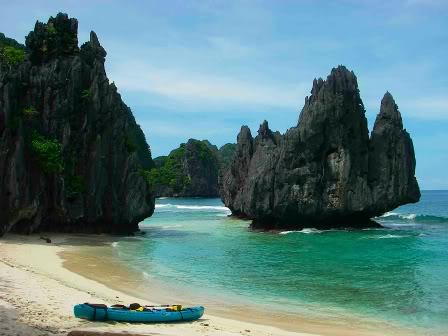
Massive limestone cliffs dot the clear torquoise waters of El Nido, Palawan. (Photo from www.e-philippines.com.ph.)

ONE of my most memorable trips has got to be in El Nido, in northern Palawan.

Take a pump-boat ride and marvel at the colossal limestone cliffs or swim in the clean waters of Bacuit Bay where you can see schools of colorful fishes and other marine life. Or why not stop by a sandbar and enjoy the cold powder-fine, white sand under your feet?

Where to stay: Miniloc Island Resort (www.elnidoresorts.com) is in itself a tourist attraction, with its lush surroundings and water cottages built on stilts.

A must-see in Palawan is the Puerto Princesa Underground River, which has been gaining a massive amount of publicity since it was named one of the New Seven Wonders of Nature. The main attraction is the St. Paul’s underground cave where stalactites and stalagmites have formed over the years.

Where to stay: Hotel Fleuris in Puerto Princesa (www.fleuris.com) loves hosting groups—whether families or friends, so make sure you avail yourself of its barkada package.

By no means is this list complete. There are so many other gorgeous places to visit in the Philippines, and where travelers are assured of warm smiles and fun times.

(This piece was originally published in the BusinessMirror, Feb. 26, 2012. All photos by this blogger, unless otherwise specified. All rights reserved.)

August 14, 2011

Leon Archibald Po: By his father’s rules

BEFORE the August 5 hearing on the Philippine National Police’s (PNP) overpriced choppers, not too many Filipinos may have probably heard of Archie Po. People who know him are mostly in the tight-knit world of aviation, the privileged few who often charter aircraft to get where they’re going, and those in the market for helicopters.

A pilot himself, Leon Archibald Po owns LionAir Inc., the licensed distributor and service center of the Torrance-based Robinson Helicopter Co., the world’s leader in civil helicopter manufacturing.

He is one of the most sought-after men during the election season. His fleet of choppers and planes provide electoral candidates the needed campaign boost to cross the many islands of the archipelago.

And Po has flown them all—Gloria Arroyo, Joseph Estrada, the late Fernando Poe Jr., Chavit Singson, etc.—representing all colors of the political spectrum. “Of course, we’re non-partisan about it. Everyone is welcome to charter our choppers and planes,” he told me in an interview in December 2009. Even then, there was already an interesting mix of politicians or their representatives ringing him up, requesting his support for the May 2010 elections.

Sincere and unassuming

Archie Po, in December 2009, posing with his fleet of choppers at the LionAir Inc. hangar at the Manila Domestic Airport in Pasay. He is the usual go-to-guy during the election season. (Photo courtesy Asian Dragon)

From the short time I came to know Po, I saw him as a sincere, unassuming man. He is not someone who exactly stands out in a crowd because he is usually dressed down, wearing ordinary short-sleeved polo shirts and faded jeans, his feet shod in rugged sporty shoes. (That coat and tie worn during the Senate hearing was a definite stretch for him.)

As most men are wont to in pissing contests among themselves, he can also talk big, but not annoyingly so. Usually there is a lot of laughter accompanying his storytelling, but he doesn’t hesitate to poke fun at himself. He is certainly more comfortable speaking among friends in small groups, than in large gatherings where polite behavior and order is required. He takes the occasional drag on cigarettes, but doesn’t consume any alcohol as he is allergic to it, the same way his other siblings are.

Essentially, he struck me more as a dreamer, who merely wants a comfortable life for his wife and children—in the same manner he and siblings were brought up—as well as respectable returns on his various businesses. He is often thinking up of some new enterprise or some new project venture—“malikot mag-isip” is probably the apropos term to describe him.

But as a businessman, he didn’t appear to me as someone who would shake down others to get excessive commissions on deals. In fact, like most Filipinos, he, too, was just tired of the old political setup where red tape, unscrupulous politicians and double-dealing government officials were the norm, that’s why he was looking forward to the 2010 polls. Mostly, we talked about ways he could contribute to help the country regain its once-mighty economic status, a reality when he was growing up in the late ’50s.

But the path hasn’t been easy for businessmen like him.

“The bureaucracy has become a turnoff for most investors,” Po contends. “Alam mo, nagpagawa pa kami ng study nun—‘The Critical State of the Aviation Industry in the Philippines.’ Pinadala ko sa Congress. Pinagawa ko pati ’yung magkano binabayad namin sa gasoline. Kalokohan ’yung mga ibang taxes imposed on us investors. Airplanes are the bridges to our country, then you will impose too many restrictions?”

“In 1978 when I was in Malaysia, we were ahead in the airline industry and in technology,” he continues. “Now, lampaso na tayo. We’re the last in Asia. And now, bagsak pa tayo sa FAA [US Federal Aviation Administration]…Category 2 status na naman tayo,” he rants. It is the only time I hear him raise his voice. But after investing heavily in the local aviation business for some 30 years, who wouldn’t feel exasperated?

With his security now at risk since he came out and testified against some powerful political personalities in the PNP choppers anomaly, Po is understandably having sleepless nights these days. He is constantly on the move and doesn’t spend long hours in any one place, I am told. And meetings with lawyers occupy most of his time. This furtive life as a whistleblower is obviously not the one he had envisioned for himself and his family.

A boy and his paper planes

The toddler Archie, with his father, Joaquin Po Sr., founder of Popular Bookstore. (Courtesy Po family)

The sixth child among eight siblings, Po is a self-made businessman, learning much of the aviation industry on his own. His backstory on how he became an eventual success amid a challenging business environment, and after basically being a screwed-up teenager, is a page-turner.

The youngest boy of Joaquin Po Sr., founder of Popular Bookstore, and Flordeliza Legaspi (there are three other siblings from the elder Po’s first wife who had passed away), the young Po was once considered a brilliant student. “My parents were ultra-proud of me because I was only one of three students [in Lourdes School, Quezon City] who was accelerated to first year high school from grade six. I didn’t pass grade seven anymore,” he narrates.

But somehow, he lost his way while he was in high school, getting hooked on certain vices ­even he disdains to mention now, by the time he reached junior year. He was kicked out from Lourdes, then transferred from one school to another, finally graduating from San Sebastian College in Cavite.

For someone like his father who placed a great deal of value on learning, Po was certainly more than a disappointment. “Ako lang ang pinalayas mula sa bahay. As in ‘I don’t want to see your face!’” he quotes his father. He was 15 then and for one year, he and his father didn’t see or speak to each other, while he stayed with an uncle. They eventually reconciled after a year, when relatives intervened to patch the two up.

Instead of going into engineering at the Mapua Institute of Technology, as his father had wished—the Mapuas were family friends—Po took up a vocational course in aircraft maintenance and enrolled in flying school in 1973. “It’s always been my dream to fly. Any child’s dream is to fly, isn’t it? You start off with paper airplanes and that sort of stuff,” he recalls.

It was in flying school that his talent for business emerged. He borrowed money from his father, and along with a flight school buddy, Edwin Almeda, bought an airplane to lease to their classmates. “I told my Dad it was just like he was accelerating his payment for my flying lessons. I told him to lend me the money, then after we finish [flying school], I’ll sell the plane and give back the money to him.” A year-and-a half later, he fulfilled that promise to his father, and paid back the loan. Not only that, Po graduated in just a year, becoming the youngest pilot at 18 years old.

With a passion for the fast life, Po was also into motorbikes in the 1970s, becoming among the top motocross riders in the country as a member of Team Honda. But after busting up his leg in one ride, he decided to finally put his aviator skills to work.

From crop duster to airline owner

One of his first jobs as a pilot was as a crop duster in Malaysia in 1978, where he earned a fortune. “It was a high-risk, high-return job. You’re flying six feet above the trees but getting paid a bundle. We were paid per takeoff per ton. I make 100 takeoffs and landings in one day at $175 per takeoff, plus basic. Not bad, right?”

No longer just a boy and his paper planes - here teenage Archie flies the real thing in an undated photo. (Courtesy Po family)

By the time he was 24, he felt that the risk was not worth it. “I felt I would die in that job,” Po says. So he returned to Manila in 1980 and became the personal pilot of then Makati Mayor Nemesio Yabut.

He went on to set up Airspan Philippines which, after the Edsa People Power revolt in 1986, became the air transport of choice for high-powered politicians of differing persuasions during national elections. Between elections, Airspan shuttled hotel guests from the airport bypassing the traffic gridlock below.

By the time he sold Airspan in 1997 to JAKA, the Enrile family corporation, Po was heavily involved in Asian Spirit, and became instrumental in helping the airline expand its operations. It was the perfect time for a small airline to take flight. Philippine Airlines had pulled out of its missionary routes after its crippling financial difficulties forced a streamlining of operations, leaving Asian Spirit in the clear to dominate those routes.

He later sold his shares to CATS founder Antonio Ang in May 2007, sensing more difficult days ahead for the airline industry, what with the constant fuel price increases and increasing competition from more flexible carriers. “But by then, I already helped increase the value of our shares,” Po says with pride.

Expanding to tourism

Along with LionAir, which he set up in 2002, Po co-owns Executive Jets Asia (EJA), in partnership with American and Asian air transport experts. Based in Singapore, EJA offers executive jet charters in the region, although much of the business is now into air ambulance service.

“All our jets are convertible to air ambulances,” he explains, adding that the planes, mostly eight-seaters, are chartered by hospitals, insurance firms and individuals needing quick medical evacuations for critical medical conditions. “We bring in patients as far as Nepal and India to hospitals in Singapore, and also from Manila.”

In December 2009, he opened his 59-room boutique hotel in Boracay called Hotel Soffia. “It has always been a dream of mine to build a hotel on this island, which I passed so often during my flying days in the 1980s.”

This is the second boutique hotel to his name after the 48-room Hotel Fleuris in Puerto Princesa, Palawan, said to be a “favorite” among diplomatic embassies and consular offices, because of its reasonably priced rates. “I spent so much money on Fleuris, that I wasn’t looking for an ROI [return on investment]. A free lunch and a free dinner there, that’s good enough for me!” Po laughs heartily. “Like Soffia, it was just a dream to build that hotel.”

Last we spoke, he was considering to build another hotel, this time in Basco, Batanes, and was evaluating other possible hotel and resort sites in the country.

“I think the Philippines has no way to go except tourism. That is what will save our economy, not manufacturing, which is already the stronghold of China,” he stresses.

The hotel business “will give you money, but the returns aren’t as huge,” Po notes. “For years, I was in the business of high-risk, high-return investments. In hotels, eto ’yung mga ‘you’re getting older,’ and so you’ve mellowed down to a low-risk, low-return investment. Returns in the tourism industry are small, but solid. And your base, your property, appreciates. So you won’t go wrong.”

His dad’s respect

When pilots are lacking, Po usually takes the wheel of his choppers and personally flies his customers.(Photo courtesy Asian Dragon)

Despite his 56 years on this planet, Po shows no signs of slowing down. He just wants to accomplish more and do so many things all at the same time. I surmise it’s probably a throwback to his younger years when he still felt the need to prove himself to his father. Then, as now, those who are old enough to have met Joaquin Sr. speak of him with much reverence.

Looking back, the former black sheep says his most joyful days were when he was trying to earn the respect of his father. Po would show his father that he could make good deals, buying up old planes that no longer worked, then repairing them and making them fly again. He built up his fleet from the barest to having a successful charter service, and then moving on to own an airline.

’Yun ’yung mga masasayang panahon ko. I was trying to get my Dad’s attention, his respect. What was touching was, when he told me once, mala-Ingglis pa ’yun e, sabi nya ‘Archie, what are you trying to prove? You’re richer than me!’ ’Yung parang, ‘sobra na e, you look after your health! What are you trying to prove?’ I told him, ‘No Dad, hindi naman ganun. I’m just enjoying myself.’”

The ultimate compliment his father paid to his son was in his final moments before passing on in 1997. “Pinagbilin nya sa akin ’yung mga kapatid ko,” says Po, his voice breaking ever so slightly at the memory. Despite being the youngest boy in the family, his father’s blessing has given him a significant voice in family matters. “At least kahit paano, ngayon, me ‘say’ na ako,” he quips.

I don’t know why Po turned whistleblower especially when he has so much at stake—an unsullied international reputation as a businessman, a huge network of aviation alliances, and a young family to protect. I can imagine it wasn’t an easy decision for him to make, especially with the mighty personalities he is up against. Maybe he is still just that same teenager trying to do what is right by his father’s rules.

(Originally published in the CEO Views section of the BusinessMirror, Aug. 8, 2011.)

August 02, 2011

A look at Archibald Po*

IN December 2009, I interviewed Archibald "Archie" Po, president of LionAir Inc., who had then just launched his newest business, a hotel in Boracay Island, as well as an air ambulance service in Asia. He has been in the aviation industry for more than three decades, and is one of the well-respected aviation experts and pilots in the Philippines.

Po has never been involved in any controversies before, and I don't believe he deliberately misrepresented those allegedly overpriced choppers sold to the PNP by Maptra, as brand new. The Po family is a very respectable clan whose father Joaquin, founded Popular Bookstore, which is still operated by his children today. I personally know a number of the siblings, and I've found them to be down-to-earth and very sincere people.

The case of the allegedly overpriced choppers, obviously involve unseen, and much bigger hands, and only the PNP officials involved in the purchase can shed light on it:

Former Asian Spirit owner diversifies into tourism, air ambulance


BORACAY ISLAND, Aklan—Archibald Po, former majority shareholder of Asian Spirit (now Zest Airways), is now going full blast in his investments in the tourism industry by opening another boutique hotel.

A pilot by profession, Po also recently set up an air ambulance service in Singapore, bringing in patients as far as Nepal and India to hospitals in the city-state.

In an interview, Po said his new resort, called Hotel Soffia, was built at a cost of P100 million under his property concern, Kifessia Realty Corp. “It’s always been a dream of mine to build a hotel on this island, which I passed so often during my flying days in the 1980s.”

Architect/interior designer/master plumber Chi-chi Victoriano, who also did the Amorita Hotel in Bohol, designed the boutique hotel. Because he is an environmentalist, Po explained that the hotel uses only natural lighting aside from its energy-saving light bulbs, solar heaters, and filters its waste in a leaching field which produces fertilizer, instead of emptying into the island’s sewerage system.

It employs 50 employees in three shifts for its round-the-clock operations, making it a “very lean” hotel, he added. Room rates of the hotel are “affordable”, ranging from P3,500 ++ (standard, twin/triple-share) to P5,000 ++ (superior, twin/triple-share).

Although nestled on a hill in barangay Yapak, the hotel, Po said, will attract Boracay tourists who want quiet and privacy, but still need quick access to the restaurant strip and main white beach. “You just relax here and swim in our infinity pool. Or have your cocktails while taking in the 340-degree view of the island. If you want to go to the beach or the party places, we’ll transport you there. It’s only seven minutes away.”

This is the second boutique hotel to his name after the 48-room Hotel Fleuris in Puerto Princesa, Palawan, built at a cost of P90 million. Said to be a “favorite” among diplomatic embassies, consular offices, Fleuris is now on its 11th year of operation, “but it still looks brand new,” said Po. At least 84 percent of Tripadvisor members who have stayed at Fleuris have dubbed it the “cleanest and friendliest” hotel in Puerto Princesa.

Po said he is considering to build another hotel in Basco, Batanes, and is currently evaluating other possible hotel sites in the country.

“I think the Philippines has no way to go except tourism. That is what will save our economy, not manufacturing, which is already the stronghold of China,” he stressed.

Meanwhile, Po recently bought a Hawker jet to beef up his fleet of air ambulances via Executive Jets Asia, a company in partnership with other Asian and American air transport experts.

Po said he invested some $4 million in the company, based in Selatar Airport (East Camp), Singapore, supplying the company’s four-plane fleet. The company also provides cost-effective executive jet transport services to the region’s high-powered businessmen.

“All the jets are convertible to air ambulances,” he explained, adding that the planes, mostly eight-seaters, are chartered by hospitals, insurance firms and individuals needing quick medical evacuations for critical medical conditions.

Po praised the Singapore government for its efficient bureaucracy, allowing businesses to operate with the most minimal permits and signatures required. “An air ambulance, for instance, has to mobilize quickly in less than 45 minutes,” he stressed.

He said he is eyeing to invest another $2 million to expand the operations and maintain four planes in Singapore. He is also eyeing to expand to other countries.

Po also operates LionAir Inc., a charter service with 20 helicopters and two LET aircraft. The company is also the licensed distributor and service center of the Torrance, California-based Robinson Helicopter Co. in the Philippines. A number of well-known politicians and high-profile businessmen in the country are owners of Robinson choppers. LionAir is also the favorite go-to charter service by politicians running in national elections.

In 1995 Po set up Asian Spirit with two other businessmen—Antonio Turralba Jr. and Noel Oñate—capitalizing it a cost of $3 million. In May 2007, he sold his shares in the airline to Antonio Ang, founder of CATS, the distributor of Mercedes-Benz locally. Ang, in turn, along with the airline’s minority shareholders, subsequently sold their shares to juice king Alfredo Yao in March 2008.

*This piece was originally published in December 2009 in the BusinessMirror.

January 20, 2008

Good reads (and another thing Pinoys should be proud of)

From The Economic Consequences of Mr. Bush by Joseph Stiglitz, former chief economist of the World Bank and Nobel Prize laureat:

"Up to now, the conventional wisdom has been that Herbert Hoover, whose policies aggravated the Great Depression, is the odds-on claimant for the mantle “worst president” when it comes to stewardship of the American economy. Once Franklin Roosevelt assumed office and reversed Hoover’s policies, the country began to recover. The economic effects of Bush’s presidency are more insidious than those of Hoover, harder to reverse, and likely to be longer-lasting. There is no threat of America’s being displaced from its position as the world’s richest economy. But our grandchildren will still be living with, and struggling with, the economic consequences of Mr. Bush....

"Whoever moves into the White House in January 2009 will face an unenviable set of economic circumstances. Extricating the country from Iraq will be the bloodier task, but putting America’s economic house in order will be wrenching and take years."

Read on at Vanity Fair.

Also, from the Asian Sentinel, a story on vigilantism, female style:

"A rambunctious and fearless posse recognizable by their pink-colored saris, the Pink Gang is the nemesis of violent husbands and inept government officials. Having personally suffered abuse, members of the vigilante club thrash abusive men, wife beaters and rapists, confront and shame wrongdoers and storm local police stations to accost lackadaisical cops."

Watch out men. We're on to you.

* * * *

Proudly Pinoy again

The Manila Standard Today reports that Lagen and Miniloc islands' resorts have been included in Travel + Leisure's 20 Favorite Green Hotels in its January issue. Actually, the issue was November 2007. Anyway, here is the relevant passage, as quoted by MST on Jan. 19:

“Surrounded by 123,000 acres of protected forests, jagged limestone cliffs, and hidden lagoons, travelers to sister resorts El Nido Lagen Island and El Nido Miniloc Island can take their pick of daily activities: bird-watching, kayaking, rock climbing, or simply watching fish swim below one of the guest cottages-on-stilts, which are set above the crystalline ocean.”


The El Nido resorts were actually ranked number eight out of 20 resorts wordwide, coming after well-established and major establishments in the Maldives , the Swiss Alps, and Bahamas. Just goes to show the Philippines still has something to be proud about.